How to Choose Concrete Mixer Pump Capacity for Your Project?
Choosing the right concrete mixer pump capacity is essential for your construction project. It influences construction efficiency, costs, and reliable concrete supply. If your concrete mixer with pump machine has insufficient capacity, it may slow down your project. While, an oversized model can increase both the equipment and operating costs.
When selecting a concrete mixer pump machine, you need to consider more than the theoretical pumping output. Pumping distance, delivery pressure, concrete mixing capacity, power sources, and jobsite conditions all affect actual performance.
Here you can learn how to calculate your required capacity and choose a suitable concrete mixer pump for your construction project.
What is Concrete Mixer Pump Capacity?
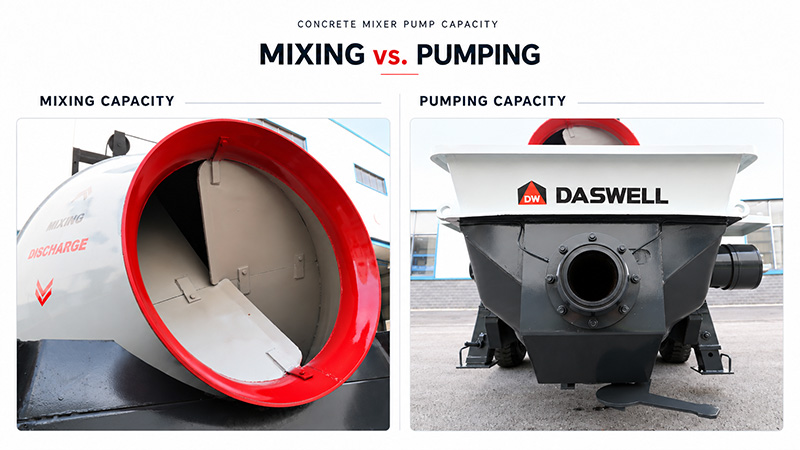
Concrete mixer pump capacity involves two key specifications: mixing capacity and pumping capacity. Knowing their differences, you can select equipment better for your project’s requirements.
For example, a concrete mixer pump may have a theoretical pumping capacity of 30 m³/h and a theoretical mixing capacity of 15m³/h. They are different rated outputs for these two functions. Therefore, when choosing a concrete mixer pump, you should check both specifications rather than relying on pumping capacity alone.
What Are the Pumping Distance, Height, and Pressure of Your Project?
Concrete pumping performance depends on more than the rated output. The required delivery distance, vertical height, pipeline layout, and concrete properties all affect pumping resistance.
Before purchasing, you should determine the maximum horizontal distance and vertical height from the pump to the pouring point. Meanwhile, the pipeline diameter, total length, and number of bends also influence the pumping performance. Longer pipelines, greater vertical lifts, and complex layouts can increase pumping resistance and reduce actual output.
Delivery pressure is another important factor. A pump must generate sufficient pressure to transport concrete through the planned pipeline.
Here are the theoretical parameters of our diesel concrete mixer pumps for your reference.
| Model | Theoretical Pumping Height | Theoretical Pumping Distance | Pumping Pressure |
|---|---|---|---|
| DMP 30 | 30 m | 100 m | 6 MPa |
| DMP 40 | 50 m | 200 m | 8 MPa |
| DMP 50 | 120 m | 500 m | 10 MPa |
If you do not know which model is suitable for your project, please share your pipeline layout and site requirements with us. Our professional engineer will help evaluate a suitable model for your project.
What Are Your Mixing Capacity and Aggregate Size Requirements?
When choosing a concrete mixer pump, you should check not only the rated pumping capacity, but also the mixing capacity and the maximum aggregate size. These specifications affect whether the machine can provide a continuous and stable concrete supply for your project.
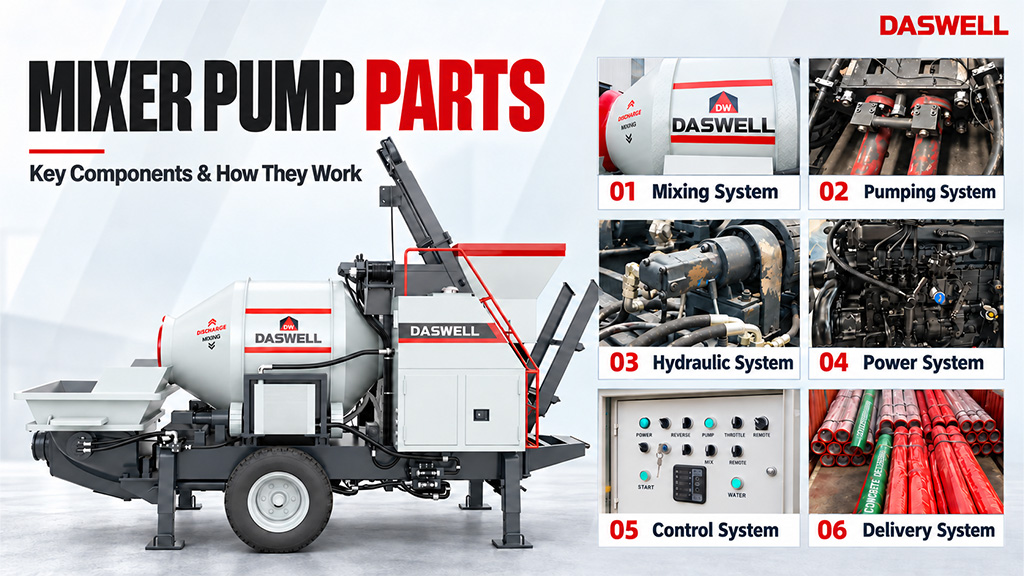
Mixing capacity determines how much fresh concrete the mixer can prepare within a given period. Generally, our concrete mixer pumps are equipped with a JZM450-series mixer. Its theoretical mixing capacity is 15m³/h.
If your project requires a higher continuous pumping output, you should confirm whether the mixing system can supply enough concrete to keep the pump running efficiently. If mixing capacity is insufficient, the pump may have to wait for concrete, reducing actual output.
You can contact our engineer for discussing whether the mixing capacity is suitable for your project or not.
For your higher concrete supply requirements, an additional supply arrangement may be necessary. We also have self-loading mixers for on-site concrete production.
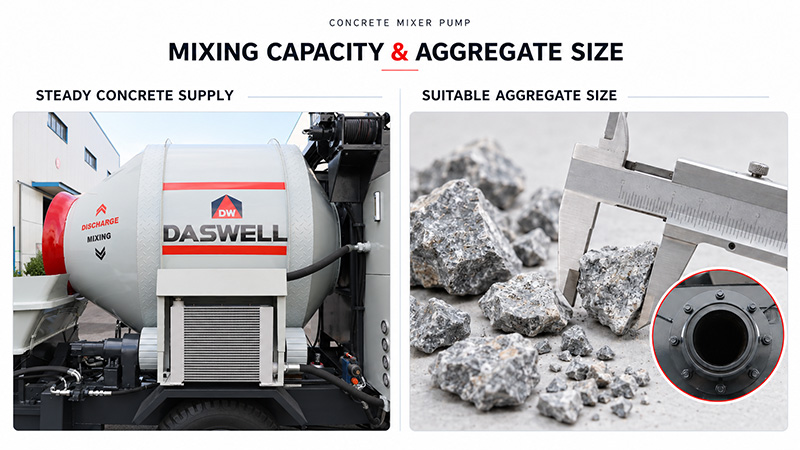
Aggregate size affects both concrete mixing and pumping. During mixing, the aggregate size and grading influence the uniformity of materials’ distribution. During pumping, oversized aggregates or unsuitable grading may increase pipeline resistance and the risk of blockages.
Therefore, you should check the maximum permitted aggregate size of the mixer pump. It should match your concrete mix and pipeline configuration. Generally, our listed maximum aggregate sizes of mixer pumps are 40 mm.
If you can not make sure whether your materials are suitable for mixer pump or not, just send messages to us.
How to Calculate the Required Mixing and Pumping Capacity?
After evaluating your pumping conditions, mixing requirements, and aggregate size, the next step is to estimate how much concrete your project needs per hour. This helps you choose a concrete mixer pump with suitable capacity.
Which Pumping Capacity Do You Need?
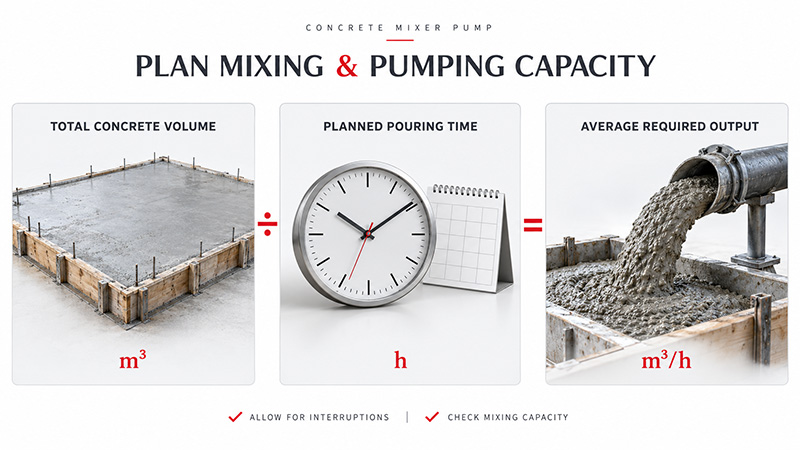
The typical formula for calculating the pumping capacity is: Required Pumping Capacity = Total Concrete Volume ÷ Planned Pouring Time
If your project requires 120 m³ of concrete within 10 hours, the average required output is 12 m³/h.
However, for your actual construction project, you had better allow for interruptions and consider pipeline conditions and concrete supply.
Does the Mixing Capacity of Concrete Mixer Pump Match Your Requirements?
The mixing system must supply enough concrete to support the required pumping output. Generally, the theoretical mixing capacity of our concrete mixer pump is about 15m³/h. The pumping capacity varies by model.
If your project requires a higher continuous output, discuss the actual mixing and pumping performance with our engineers. We have various solutions for your construction project.
How to Choose Concrete Mixer Pump Capacity Based on Your Construction Project?
Different Projects have different concrete requirements. Daswell has rich experience on concrete mixer pump machine supply. Here are some capacities of our popular concrete mixer with pump machine for your reference.
The 30m³ model is suitable for small scale construction projects. If the concrete demand is moderate and the pumping distance is relatively short, it is worth considering. We have both electric and diesel versions. You can select the power source according to your site conditions.
If the 30m³ mixer pumping machine can not meet your needs. The 40m³ may be more suitable. It has greater pumping performance and higher capacity than the smaller machine. You can use it for multi-story building construction, larger foundations, and projects with more demanding concrete placement schedules.
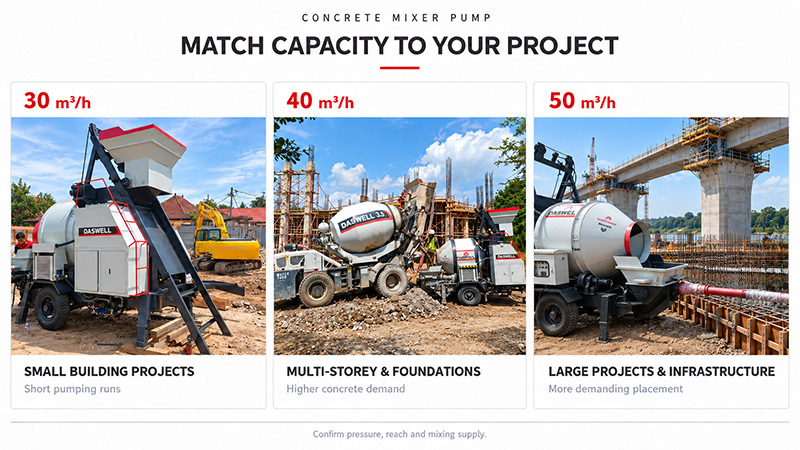
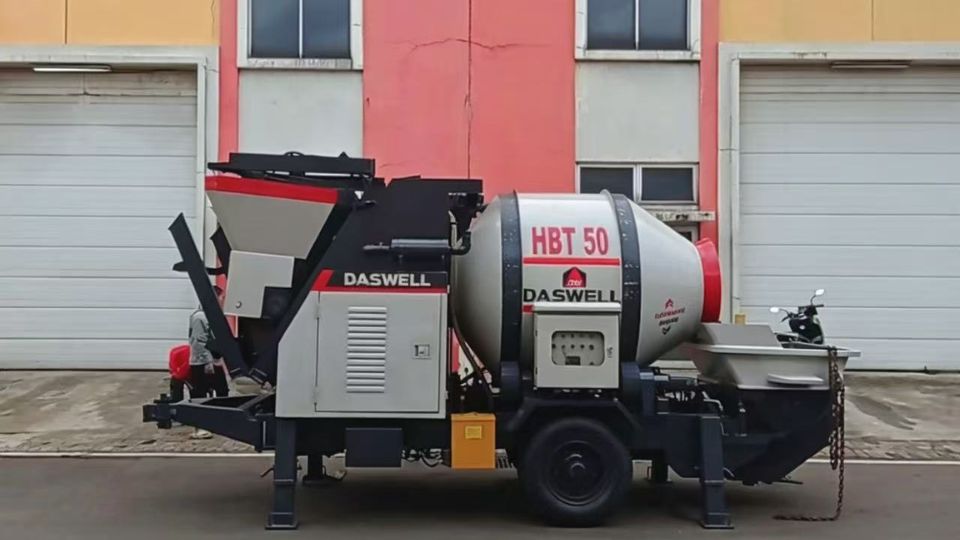
The 50m³ concrete mixer pump is one of the most popular model among our concrete mixer pumps. It can meet your needs on higher pumping capacity and greater flexibility across different construction applications.
It is suitable for larger building projects, foundations, infrastructure work, and jobsites where concrete must be delivered over longer distances or to higher elevations.
For projects with growing concrete demand, choosing a 50 m³/h model can also provide additional capacity for future work. Especially, the 50 m³/h diesel concrete mixer pump deserves particular consideration because of its combination of high theoretical output and independent power supply.
Contact our team with your required concrete output, pumping distance, delivery height, aggregate size, and project details. Our engineers can help you evaluate a suitable model and configuration for your application.