6 Practical Ways to Improve Concrete Batching Plant Efficiency
Have you ever been frustrated by this issue? A concrete batching plant’s rated capacity may appear high, yet actual output consistently falls short of expectations.
When this situation arises, it doesn’t necessarily mean the equipment itself has malfunctioned; it could be that a specific stage of production is slowing down the entire process. To boost the plant’s capacity, one can’t focus solely on mixing speed; the coordination between various operational stages must also be considered.
Below, let’s introduce some practical improvement methods across six areas to enhance concrete production efficiency while minimizing unnecessary waste and costs.
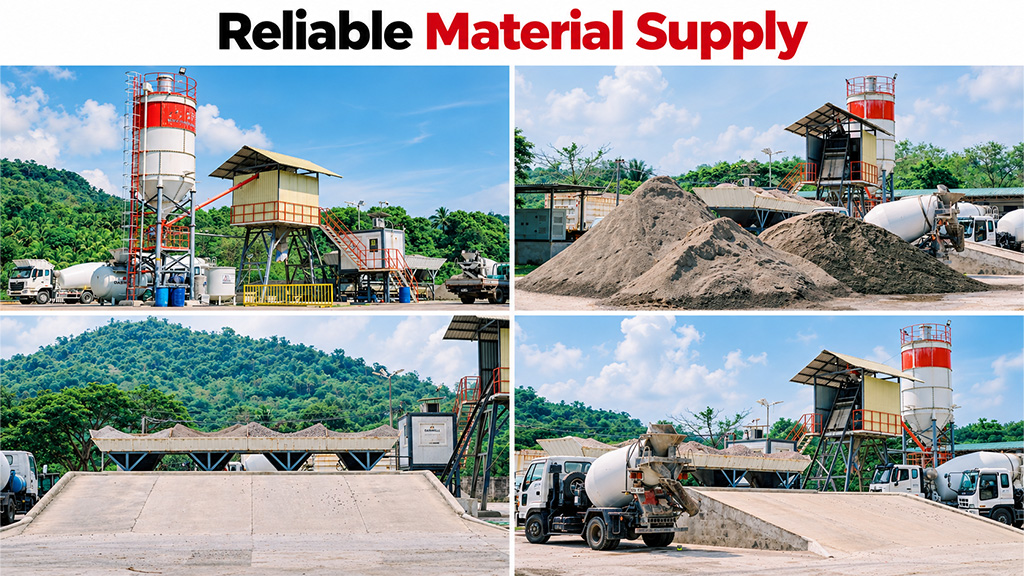
Ensure timely supply of raw materials to avoid equipment downtime
Insufficient raw material supply is a common issue in the operations of concrete batching plants.
If the aggregate bins run empty or cement silo levels fall too low during continuous production, operations must be halted. While a single pause may seem to last only a few minutes, repeated interruptions reduce overall efficiency.
1. Plan Raw Material Inventory in Advance
Estimate requirements based on production schedules and concrete mix designs; determine the necessary quantities of sand, aggregate, cement, and other materials ahead of time; establish appropriate storage areas; and replenish supplies promptly to prevent shortages during peak production periods.
Additionally, aggregates of different specifications should be stored separately to avoid mixing, which could compromise the concrete mix proportions.
2. Optimize Raw Material Transport Routes
The transportation of raw materials and concrete significantly impacts operational efficiency; as navigating a complex course, a logical sequence and route are essential for maintaining an orderly production flow.
The purpose is clear: to ensure the concrete batching plant receives supplies exactly when needed, preventing equipment downtime caused by waiting for materials.
Optimize the batching system to balance weighing accuracy and speed
If the batching system operates unstably, it affects not only efficiency but also the quality of the concrete.
Factors such as load cell deviations, material residue in the weigh hopper, or improperly sealed discharge gates can all adversely affect weighing accuracy.
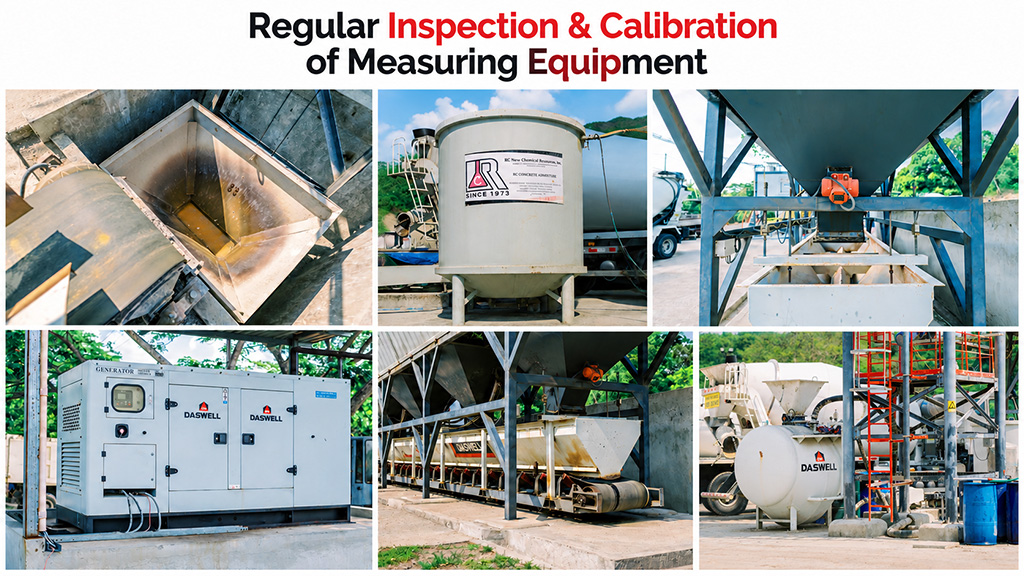
1. Regularly inspect and calibrate weighing equipment
Sand, aggregate, cement, water, and admixtures must be accurately measured according to the specified mix proportions. It is crucial to check the operational status of weighing devices, load cells, discharge gates, and related components regularly.
2. Minimize waiting times during the batching process
For batching plants using automated systems, and where equipment capabilities allow, certain weighing steps can be coordinated with other production stages to reduce unnecessary time.
3. Do not ignore aggregate moisture content
The moisture content of sand and aggregate directly affects the actual water requirement of the concrete. If aggregates are stored outdoors, significant fluctuations in moisture content can occur following rainfall.
Optimize the mixing cycle to reduce time wastage
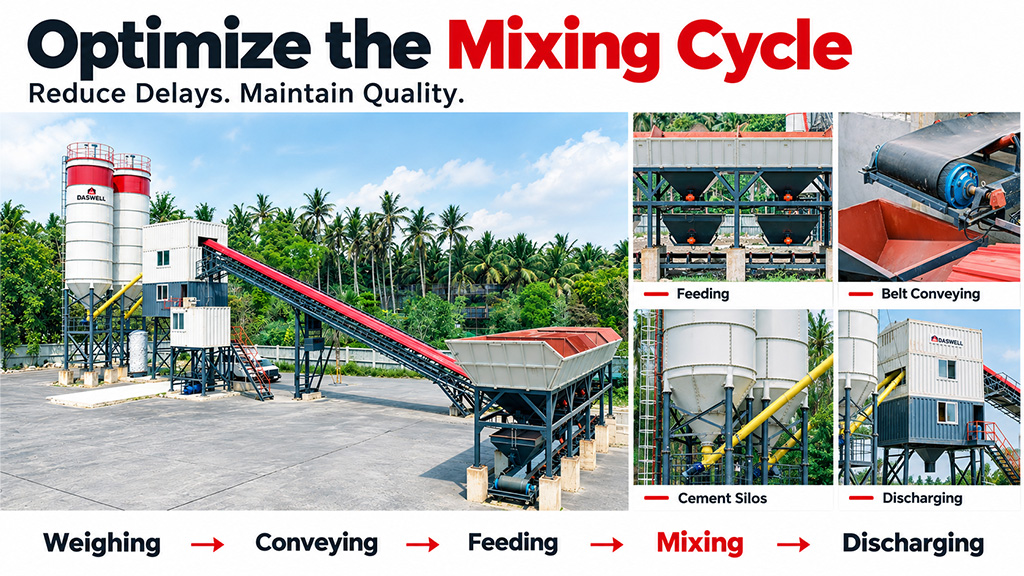
A complete production cycle of concrete batching plants typically involves proportioning, conveying, charging, mixing, and discharging.
Time requirements vary depending on the concrete mix design, mixer type, and charging method. Insufficient mixing time can lead to uneven material blending, thereby compromising concrete quality.
How can the mixing cycle be optimized?
✔ Evaluate the appropriateness of the mixing time
By considering specific operational requirements, actual mix proportions, and concrete quality, determine whether there is any unnecessary consumption of time.
✔ Check for smooth charging and discharging operations
Even if the actual mixing duration is short, the overall production cycle can be prolonged by slow aggregate conveyance or sluggish operation of the discharge gate.
It is important to clarify that the goal of optimizing the mixing cycle is to eliminate inefficient use of time—not to overload the equipment or sacrifice concrete quality for the sake of higher output.
Perform Routine Maintenance to Minimize Unexpected Downtime
In concrete batching plant operations requiring continuous supply, any issue with the main mixer, conveying system, or electrical control system can disrupt the entire production schedule.
Therefore, integrating maintenance tasks into daily operations is a smart strategy.
❗ Establish a Regular Inspection Schedule
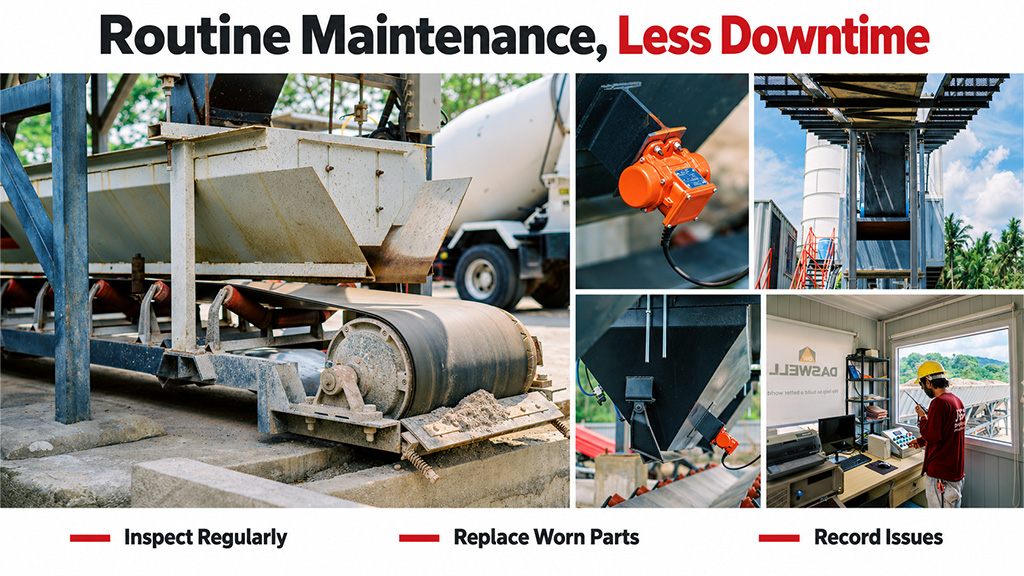
Conduct weekly or monthly inspections of equipment lubrication, fasteners, conveyor belts, pneumatic systems, and safety devices to ensure proper operation.
Also, inspect aggregate bins, conveyor belts, and conveyors to promptly address issues such as material blockages, accumulation, or poor material flow.
❗ Replace Worn Parts Promptly
Components such as mixing blades, liners, seals, and conveyor belts inevitably wear down over time.
For critical parts that are prone to damage or have long lead times, maintain an adequate inventory to prevent equipment downtime caused by waiting for replacements.
❗ Log Faults to Identify Recurring Issues
If a convey or belt frequently drifts off-track, you merely adjust it without checking the pulleys, idlers, or tensioning devices, the problem maybe recur.
Logging faults is like taking notes; it helps us categorize and analyze the issues that have occurred.
Coordinate transport vehicles effectively to synchronize production and delivery
As previously mentioned, the transport of raw materials and finished products may seem like a basic task.
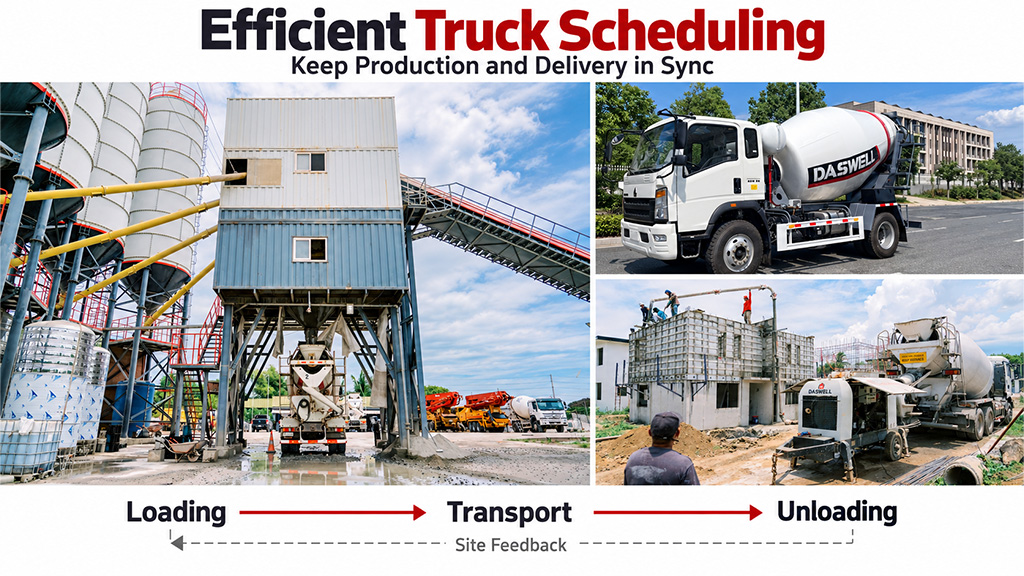
However, if loading speeds lag behind, vehicles will queue up, ultimately undermining transport efficiency.
A concrete batching plant operates as an integrated production system. When formulating production plans, it is essential to consider various factors, including the distance to the project site, road conditions, transport vehicle capacity, and the discharge rate at the construction site.
Whether operating in urban areas or remote locations, the key to ensuring efficient and stable concrete production lies in rational, coordinated scheduling.
For instance, issues such as concrete pump malfunctions, slowed pouring progress, or a temporary lack of space for unloading at the site can prevent transport vehicles from discharging their loads on schedule.
If the concrete batching plant fails to receive this information promptly and continues production according to the original plan, a backlog of concrete may result.
Stationary or Mobile? Choosing the Right Equipment
Is your project scale large or small? What is the project timeline? How do you select the right concrete batching plant for your needs?
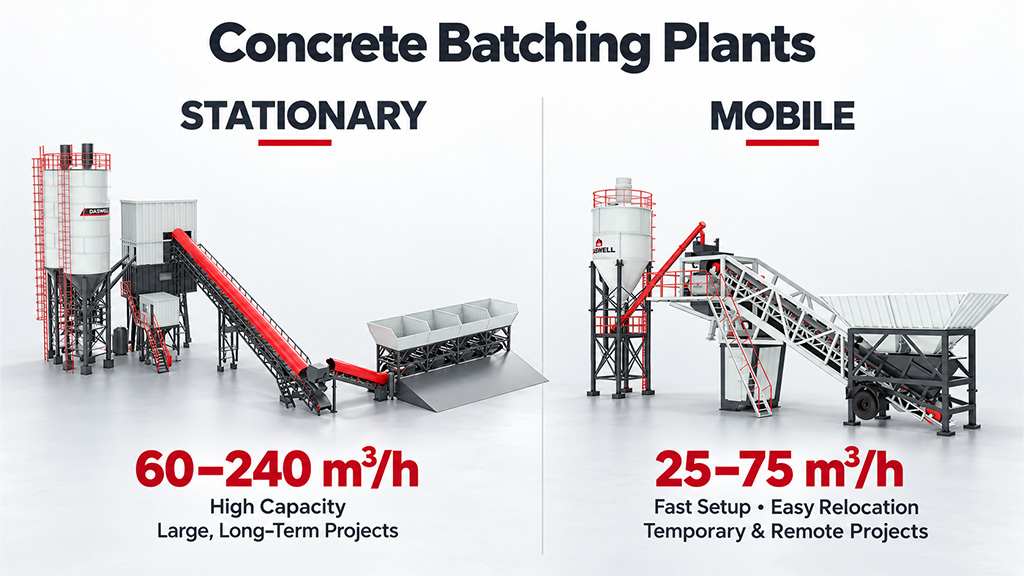
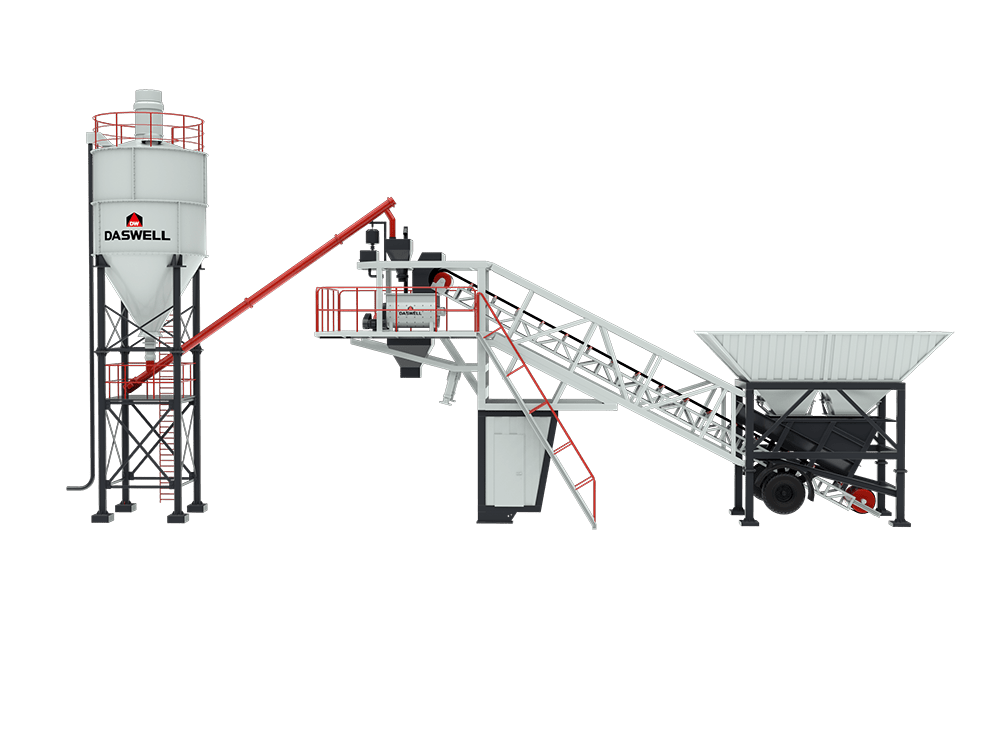
DASWELL offers two types of concrete mixing plants
For contractors requiring rapid installation, easy relocation, and reliable output, mobile concrete batching plants are the preferred choice. Compact in size and mountable on trailers or skid bases, they are perfect for remote locations or temporary projects.
Stationary concrete batching plants are permanently installed and offer high production capacities, typically ranging from 60 m³/h to 240 m³/h. They are ideal for large-scale, long-term projects such as highway construction, dam building, and urban development.
How can we know if the batching plant’s production efficiency has truly improved?