Diesel vs. Electric Trailer Concrete Pump: Which One Should You prefer?
If you are sourcing a trailer concrete pump for a construction project, diesel and electric models are likely the first two types you will compare.
In terms of operating principles, there is no fundamental difference between them. However, their distinct power sources directly impact their adaptability to the construction environment, daily operating costs, and on-site management requirements.
Now, let’s compare the key differences between diesel and electric trailer concrete pumps based on practical construction which needs to help you select the right equipment for your project.
What is the difference between diesel-powered and electric-powered trailer concrete pumps?
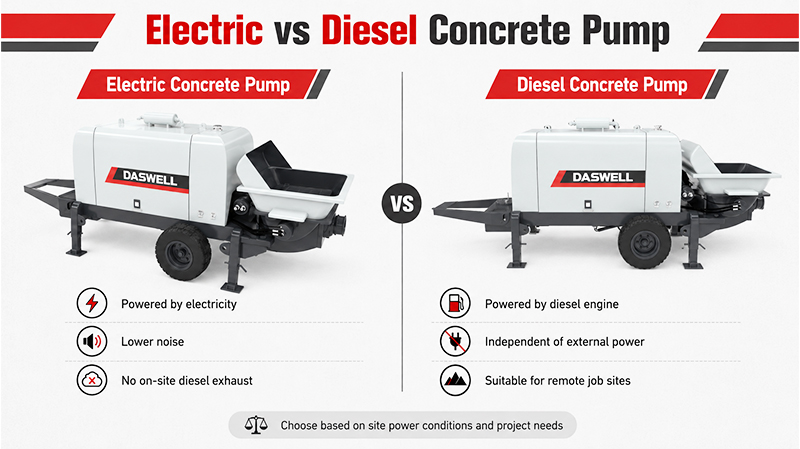
The primary difference lies in the power source. Diesel trailer concrete pumps use a diesel engine to drive the hydraulic system, whereas electric trailer concrete pumps are powered by an electric motor. Despite the difference in power sources, both types of equipment rely on a hydraulic system to drive the delivery pistons and continuously transport concrete to the construction site.
|
Comparison Item |
Diesel-Powered Trailer Concrete Pump |
Electric-Powered Trailer Concrete Pump |
|
Power Source |
Diesel engine |
Electric motor |
|
Grid Dependency |
Independent of external grid |
Requires stable power supply |
|
Operational Flexibility |
Suitable for remote sites and Frequent relocation |
Better suited for sites with Reliable power infrastructure |
|
Energy Costs |
Affected by diesel prices and fuel consumption |
Affected by local electricity rates and actual consumption |
|
Maintenance Focus |
Engine, hydraulic system, and wear parts |
Electrical system, hydraulic system, and wear parts |
|
Operating Noise |
High |
Low |
|
On-site Emissions |
Engine exhaust emission |
No exhaust emissions |
Diesel-Powered vs. Electric-Powered Trailer concrete Pumps:
Which Is Right for Your Construction Site?
Different projects have vastly different equipment requirements. Even if two units share similar theoretical pumping capacities, site conditions can lead to completely different operational outcomes.
1. Projects in Remote Areas or with Unstable Power Supplies
If you are working on rural housing, highways, bridges, or other projects located far from the urban power grid, diesel-powered trailer concrete pumps offer distinct advantages in terms of convenience.
Using a diesel pump allows the construction team to reduce reliance on external power infrastructure and schedule operations according to the project timeline.
Of course, factors such as fuel transport, storage, and refueling must be considered. If the site is extremely remote, the cost of diesel supply can become a significant expense.
2. Urban Construction and Projects with Strict Environmental Standards
Electric-powered trailer concrete pumps are well-suited for urban residential and commercial projects, as well as any site subject to regulations regarding construction noise and emissions.
However, for projects located indoors, underground, or in areas with limited airflow, you must still evaluate the site’s overall ventilation and safety conditions; the equipment’s power source alone is not the sole determinant of safety.
Additionally, while some urban projects may be close to the power grid, the grid may not necessarily provide sufficient power capacity. It is essential to verify the actual power supply conditions at the site before purchasing equipment.
Comparison of Pumping Capacity: Which type of kinetic energy is more powerful?
The pumping capacity of a trailer concrete pump depends not only on the engine or electric motor but also on the hydraulic system, concrete delivery cylinders, discharge pressure, and pipeline layout.
1. Theoretical Output and Discharge Pressure
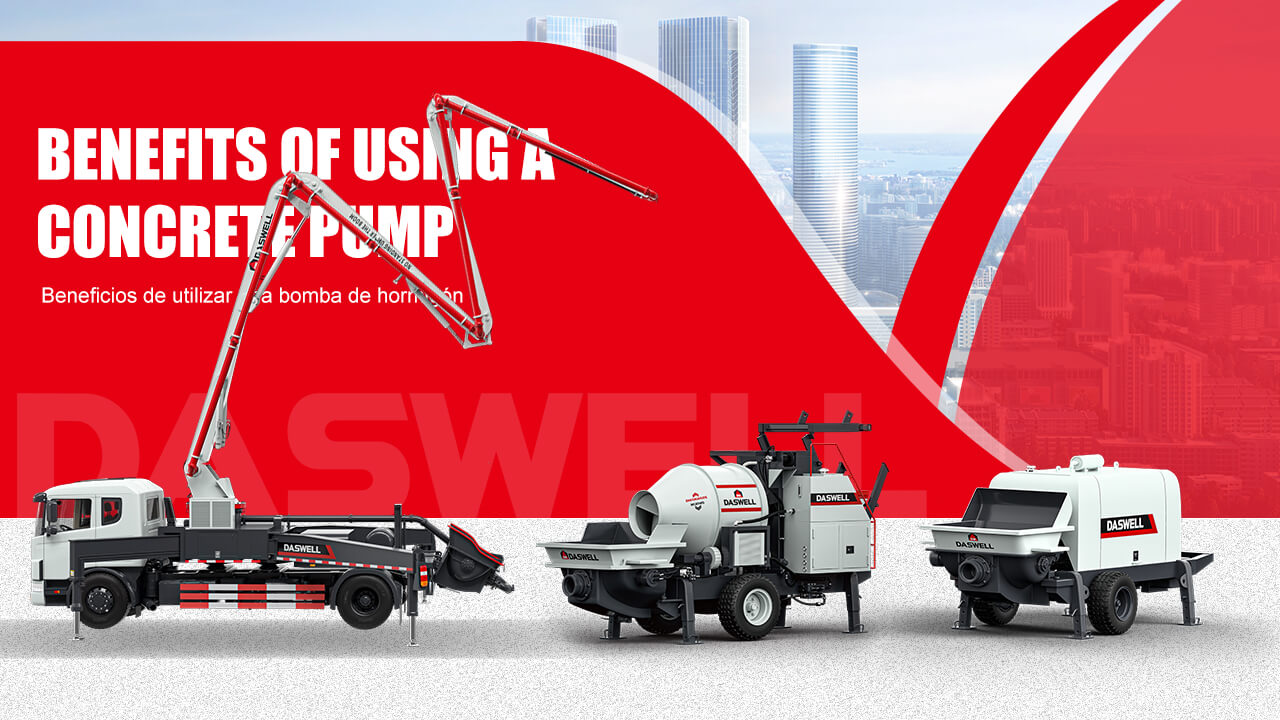
DASWELL offers diesel and electric trailer concrete pumps in various specifications to meet construction needs of different scales.
Depending on the specific parameters, both diesel and electric trailer pumps can satisfy construction requirements across various project sizes. Simply comparing the power ratings of the engine and the electric motor is insufficient to determine which unit has superior pumping capacity.
2. Actual Pumping Distance and Construction Efficiency
In addition to theoretical output, you must also consider the actual pumping distance.
For instance, on projects requiring concrete delivery to higher floors, it is essential to consider factors such as building height, horizontal conveying distance, pipeline diameter, and the number of pipe bends. All these factors influence the actual pumping resistance.
Diesel-powered vs. electric trailer concrete pumps: Which has lower operating costs?
When considering costs, the focus should be on the actual operating expenses over the entire project lifecycle, including energy consumption, maintenance, and potential downtime costs.
1. Energy costs: Fuel vs. electricity
For diesel trailer pumps, energy costs depend primarily on the engine’s actual fuel consumption, fuel prices, and operating hours.
For electric trailer pumps, energy costs are mainly determined by actual electricity consumption and local industrial electricity rates.
Accurate cost estimation requires evaluating these specific factors rather than simply basing the assessment on the equipment’s rated power.
2. Maintenance costs: How do the two types differ?
Diesel trailer pumps require regular checks of the engine oil, air filters, fuel system, and cooling system.
In contrast, electric trailer pumps require inspections of the electric motor, electrical connections, and control system.
However, both types are equipped with hydraulic systems and concrete pumping mechanisms. Regardless of the choice, regular inspection of hydraulic fluid, delivery pistons, S-valves, and other wear parts is essential.
3. Don’t overlook the cost of downtime
Equipment downtime can disrupt the entire concrete pouring schedule. For projects with tight deadlines, the reliable completion of pouring tasks is often more important than saving a small amount on energy costs.
Diesel trailer pumps may experience downtime due to fuel supply issues or engine failure, while electric trailer pumps can be affected by power outages, voltage irregularities, or electrical system faults.
DASWELL Case Show: How do trailer concrete pumps
solve concrete delivery challenges in construction?
In 2025, a DASWELL client in the Philippines utilized a DASWELL concrete trailer pump for a construction project. This project may offer you some useful insights.
In 2025, a DASWELL client in the Philippines utilized a concrete trailer pump for a construction project. This project may offer you some useful insights.
The project’s primary challenge was transporting concrete from ground level to elevated pouring areas, where direct discharge was difficult. To address this, the client employed a trailer-mounted concrete pump paired with a pipeline system to facilitate vertical concrete delivery.
During operations, the pump remained on the ground while conveying concrete through the pipeline to the elevated work zones. This setup not only minimized manual handling but also boosted pouring efficiency and streamlined the overall construction workflow.
Whether powered by electricity or diesel, trailer concrete pumps offer a practical solution for construction projects, particularly when concrete must be delivered to heights or hard-to-reach locations.
What factors should you consider before purchasing a trailer-mounted concrete pump?
If you have determined the scale of your project but are still undecided on the right choice, here are five common questions to consider:
DASWELL offers diesel and electric trailer concrete pumps in various specifications.
If you are unsure which model suits your project, contact us; our team can help you compare configurations based on your needs and provide tailored technical solutions and quotations.