Is a Trailer Concrete Pump Suitable for High-Rise Buildings?
Many buyers ask the same question: Is a trailer concrete pump suitable for high-rise buildings?
Many assume that every high-rise project requires a concrete boom pump. In fact, a trailer concrete pump is often a practical and cost-effective solution.
For many high-rise projects, this setup provides the pressure and pipeline flexibility needed for efficient concrete delivery. It can also remain in one position while the delivery line extends upward as construction progresses. It reduces site moves.
Concrete Boom Pump vs. Trailer Concrete Pump vs. Truck-Mounted Line Pump
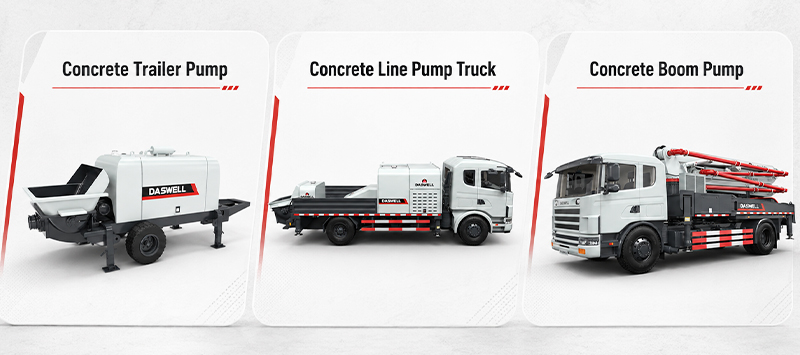
These three types of concrete pumps are often compared. The right choice depends on price, technical specifications, boom reach, and job site conditions.
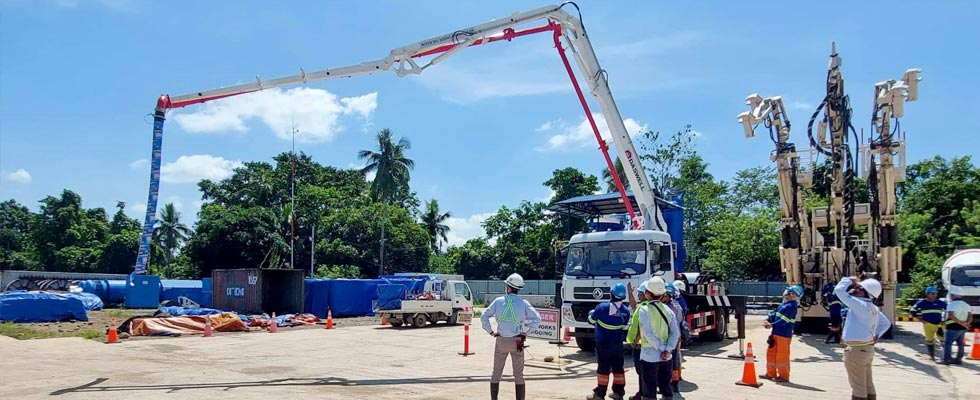
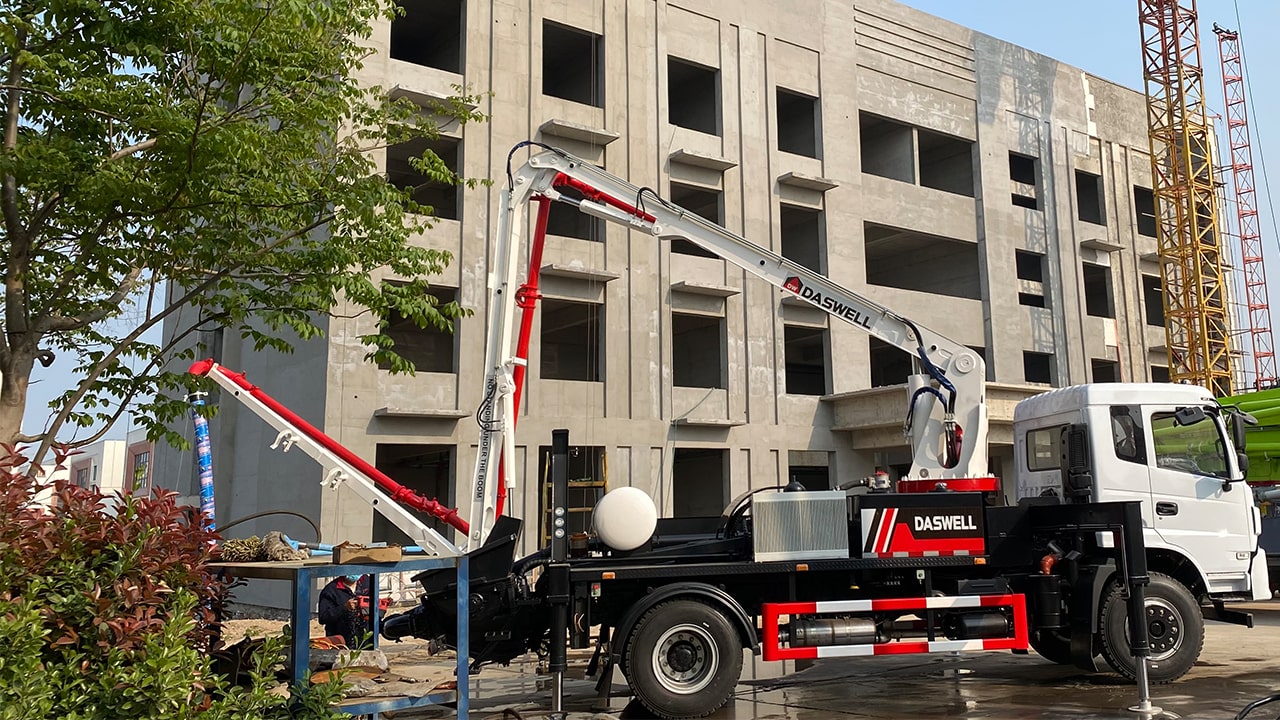
A concrete boom pump uses a hydraulic folding boom. Once the outriggers are set, it can place concrete quickly within its fixed working range without a long, separately laid pipeline. It is also easy to move between pours. However, longer booms add weight, cost, and support requirements. Boom pumps therefore suit open sites, large slab pours, and jobs where all pouring points are within reach.
A trailer concrete pump has no boom. Its hydraulic system drives pumping pistons that push concrete through a pre-laid delivery pipeline. Without the limits of boom length and weight, a high-pressure system can deliver concrete tens or even hundreds of meters vertically.
A truck-mounted line pump installs a similar pumping system on a truck chassis, improving mobility. It still needs delivery pipes or a separate placing boom, and its performance is similar to that of a comparable trailer pump.
Why Pumping Pressure Matters in High-Rise Trailer Concrete Pumping
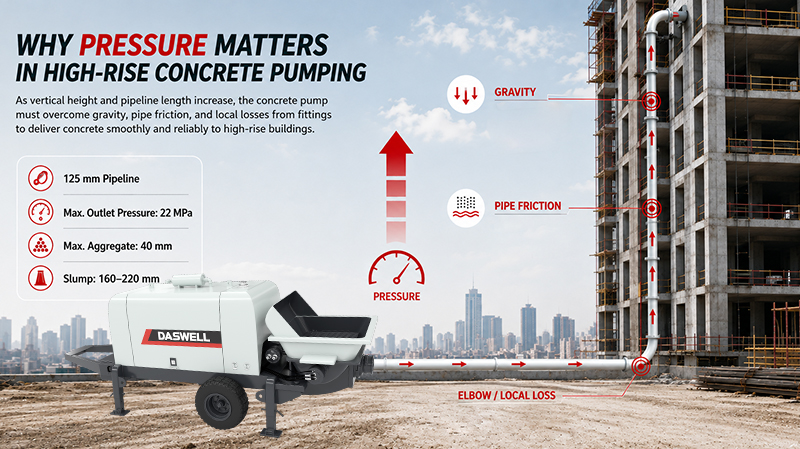
The required pressure rises with vertical height and pipeline length. The pump must overcome the weight of the concrete column, friction in straight pipes, and local pressure losses from bends, reducers, and hoses.
Stable delivery requires enough pressure to overcome the pipeline’s total resistance. Delivery pipe weight affects supports and anchors, but it does not directly create flow resistance.
Unlike a boom pump, a trailer concrete pump is not limited by boom reach. It can deliver concrete to higher floors through a fixed pipeline, provided that:
- The pump provides sufficient pressure.
- The delivery pipe has the correct pressure rating.
- The concrete has suitable pumpability.
High-pressure trailer concrete pumps are therefore common in high-rise and super-high-rise projects.
According to DASWELL specifications, mid-range models can serve buildings with about 12 to 15 floors, or a height of around 36 to 40 m. Under specified conditions, their theoretical vertical pumping distance is 90 to 100 m, and their theoretical horizontal pumping distance is 350 to 500 m. These figures describe pumping distances, not the actual building height.
For projects with about 44 floors or a height of around 130 m, a higher-pressure model can be considered. Its theoretical vertical pumping distance can exceed 130 m, and its theoretical horizontal pumping distance can exceed 600 m. Final selection depends on the actual pipeline layout and required pressure.
DASWELL trailer concrete pumps use a 125 mm delivery pipe. Depending on the model, outlet pressure can reach 22 MPa. The maximum aggregate size is 40 mm, and the specified concrete slump range is 160 to 220 mm.
Actual pumping height also depends on pipeline length, bends, pumping output, concrete mix design, and site conditions. Always leave a reasonable margin instead of selecting a pump at its theoretical limit.
How to Choose a Trailer Concrete Pump for High-Rise Construction
Trailer Concrete Pump Power: Diesel or Electric?
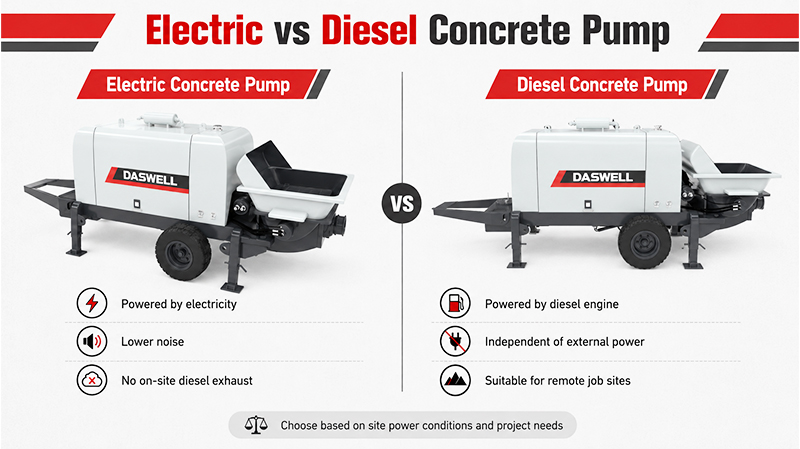
DASWELL offers diesel and electric trailer concrete pumps.
Diesel models do not need external power, making them suitable for remote sites or unstable power grids. Electric models produce no diesel exhaust on site and create less engine noise. They suit urban projects with strict noise and emission requirements, provided that adequate power capacity and cables are available.
Trailer Concrete Pump Valve: S-Tube Valve or Gate Valve?
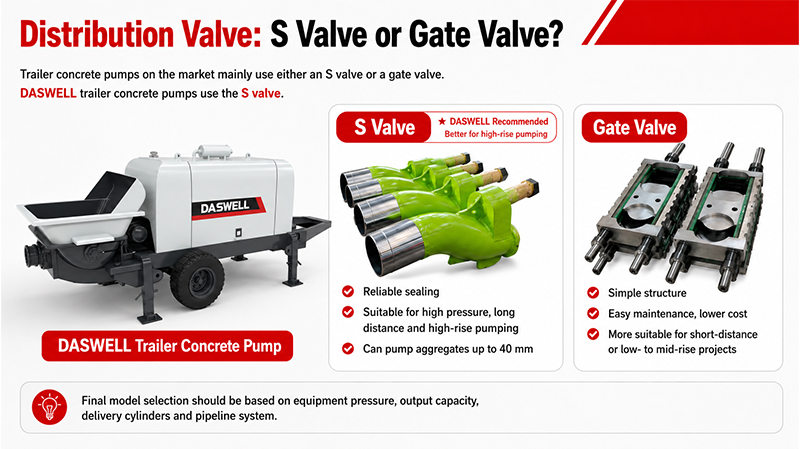
Trailer pumps mainly use an S-tube valve or a gate-valve system. DASWELL trailer concrete pumps use an S-tube valve.
The S-tube valve provides reliable sealing for high-pressure, long-distance, and high-rise pumping. DASWELL trailer pumps handle aggregate sizes of up to 40 mm, provided that the mix and aggregate grading meet pumping requirements.
A gate-valve system is simpler, easy to maintain, and usually less expensive. It is generally more suitable for shorter pumping distances or low- and mid-rise projects.
Valve type alone does not determine pumping height. Pumping pressure, output, delivery cylinders, and the pipeline system must also be considered.
Trailer Concrete Pump Placement: Manual Hose Placement or a Placing Boom?
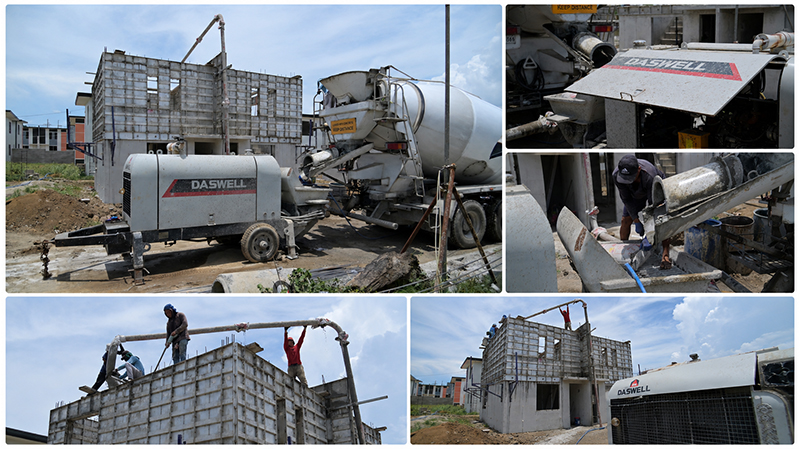
A trailer concrete pump has no built-in boom. Final distribution requires manual hose handling or a separate concrete placing boom.
A common high-rise setup uses the trailer pump to deliver concrete to the required floor. The placing boom then covers the pouring area.
All delivery pipes and couplings must have pressure ratings that match the pump. Vertical pipelines also need secure supports and anchors.
When Is a Trailer Concrete Pump Not the Best Choice?
Some job sites are limited by concrete supply rather than pumping height.
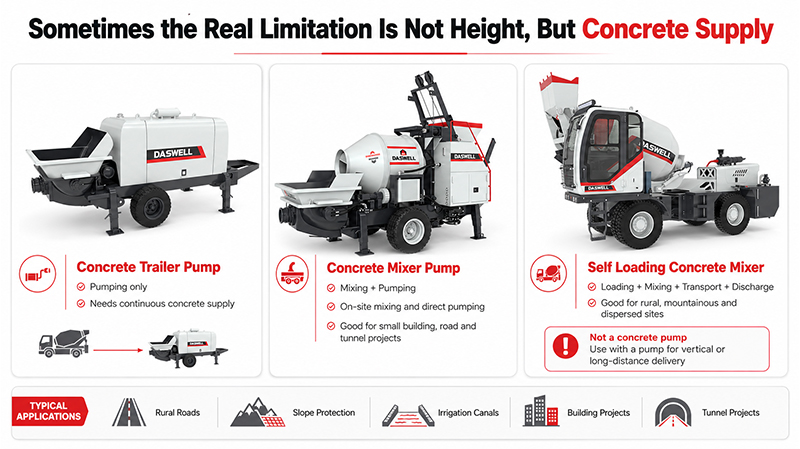
Examples include rural roads, slope protection, irrigation channels, and other projects with scattered pouring points. The same issue can affect small building or tunnel projects far from a batching plant or difficult for mixer trucks to access.
A trailer concrete pump only handles pumping. It needs a continuous concrete supply from mixer trucks, an on-site batching plant, or other mixing equipment.
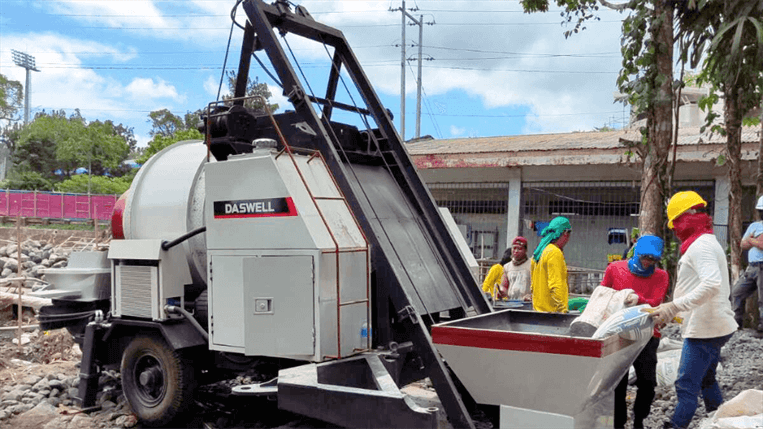
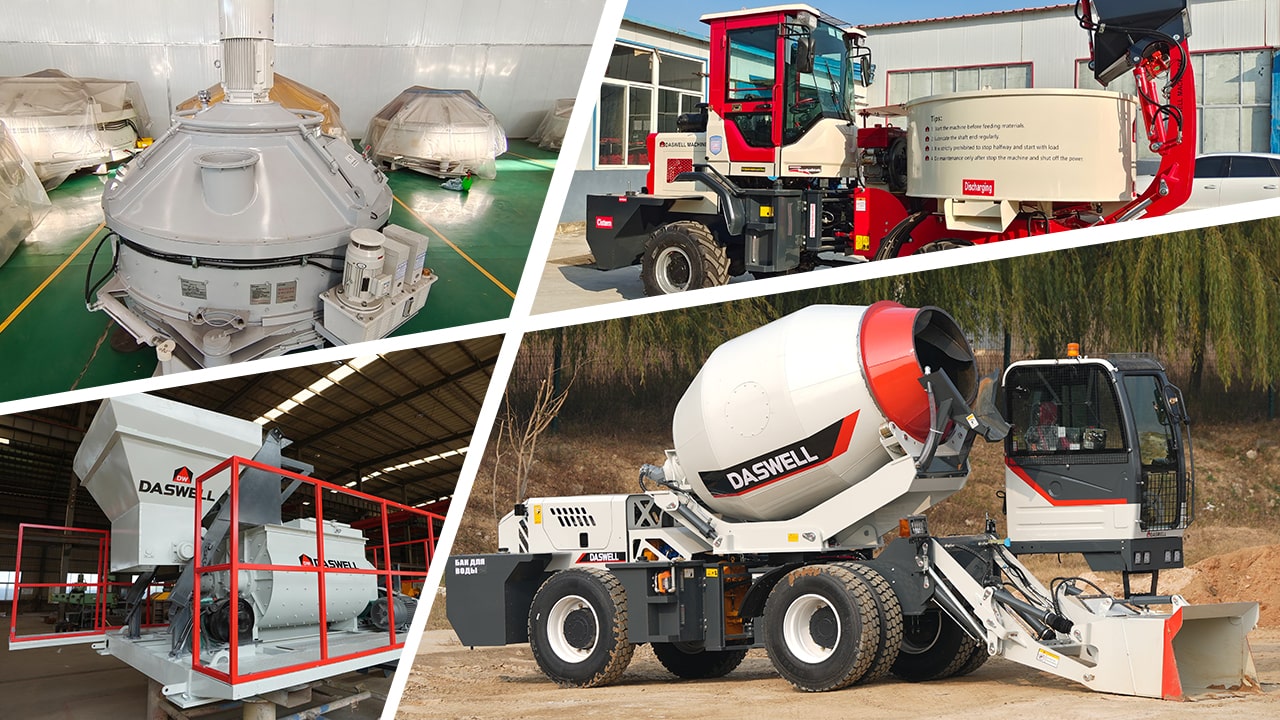
A concrete mixer pump combines mixing and pumping. It can mix concrete on site and pump it directly to the pouring point. It suits small and medium-sized building projects, road paving, and tunnel construction.
A self-loading concrete mixer handles loading, weighing, mixing, transport, and discharge. It reduces reliance on ready-mixed concrete suppliers and suits rural, mountainous, or scattered job sites.
However, a self-loading concrete mixer is not a concrete pump. Vertical or long-distance delivery still requires a separate pump.
A Simple Guide to Choosing the Right Concrete Pump
- High-rise projects using a fixed pipeline: choose a trailer concrete pump after calculating the required pressure.
- Super-high-rise or core wall construction: choose a trailer concrete pump with a high-pressure pipeline and placing boom.
- Low-rise projects with unreliable concrete supply: choose a concrete mixer pump. For on-site mixing and transport, choose a self loading concrete mixer.
- Open sites with all pouring points within boom reach: choose a concrete boom pump, especially for frequent relocation.
Contact us today for a concrete pumping solution tailored to your required pumping height, distance, output, and job site conditions.