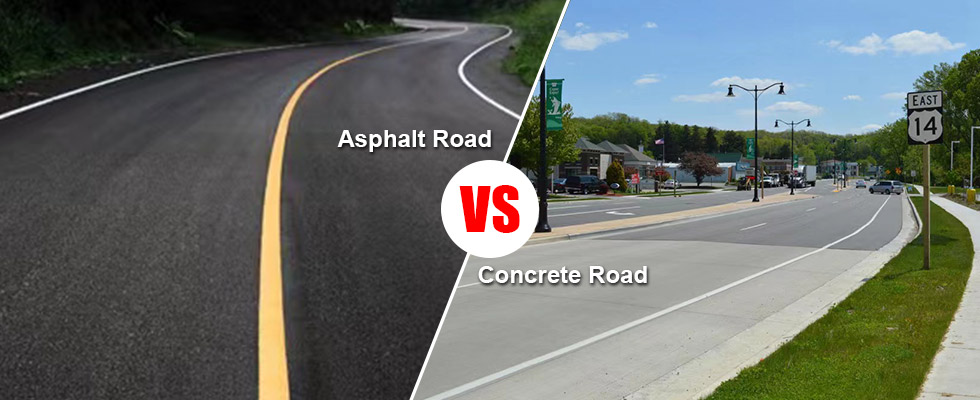
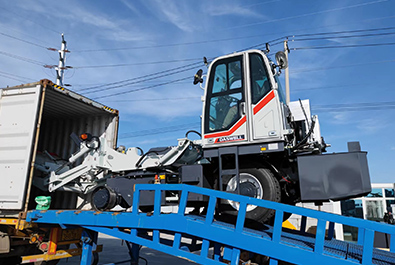
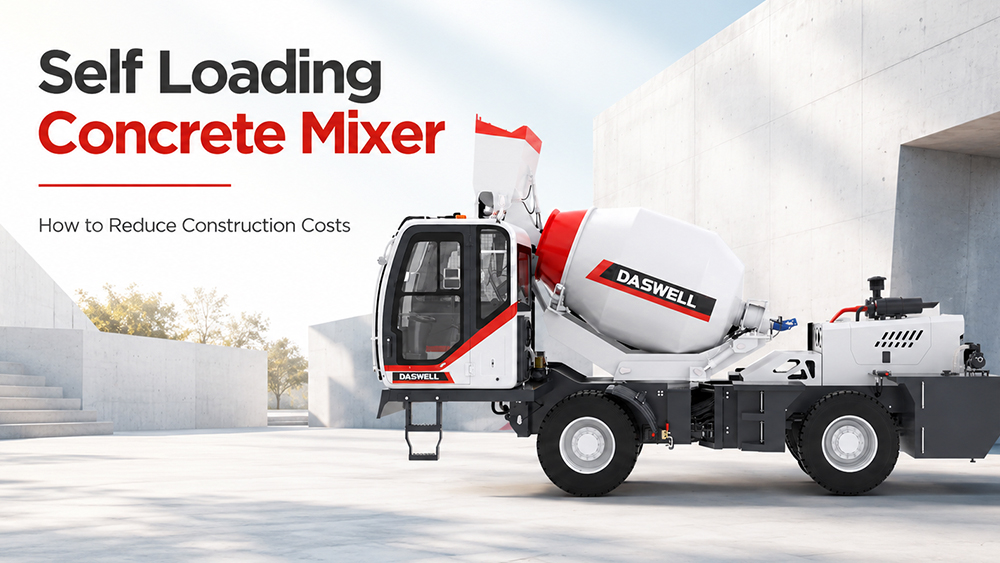
Self Loading Concrete Mixer: How to Reduce Concrete Construction Costs?
How to Reduce Construction Costs with a Self Loading Concrete Mixer?
In construction projects, concrete supply directly affects the schedule and total cost.
However, concrete supply costs are often hard to control. Ready-mix concrete prices vary by region. Remote jobsites may have difficulty arranging concrete mixer trucks. Manual loading and mixing are also slow and labor-intensive.
That is why more contractors choose a self loading concrete mixer for on-site concrete production.
A self loading concrete mixer truck combines loading, mixing, transportation, and discharging in one machine. It is efficient, cost-effective, and suitable for road construction, rural construction, water conservancy projects, infrastructure projects, and other small and medium-sized jobsites.
Cost Problems in Traditional Concrete Production
Problem 1: Ready-mix concrete increases cost and waiting time
Ready-mix concrete usually includes batching plant production cost, transportation cost, and supplier profit.
For remote jobsites, small-batch projects, or scattered construction sites, the total cost may be higher than producing concrete on site.
In mountainous areas, plateau regions, and other remote locations, there may be no commercial concrete batching plant nearby. Even when ready-mix concrete is available, waiting for mixer trucks can still delay the project.
Problem 2: Multiple machines increase total cost
Traditional on-site concrete production may require a wheel loader, a concrete mixer, and a transport vehicle.
This increases purchase or rental cost, maintenance cost, and operator cost. The jobsite also needs more workers for loading, mixing, transportation, discharging, and auxiliary work.
Problem 3: Manual loading affects efficiency and quality
Traditional drum mixers often require manual loading, and water is usually added based on experience.
This makes the water-cement ratio hard to control. If the concrete mix proportion is unstable, the concrete strength may not meet project requirements, causing rework and extra cost.
Design Highlights of Self Loading Concrete Mixer
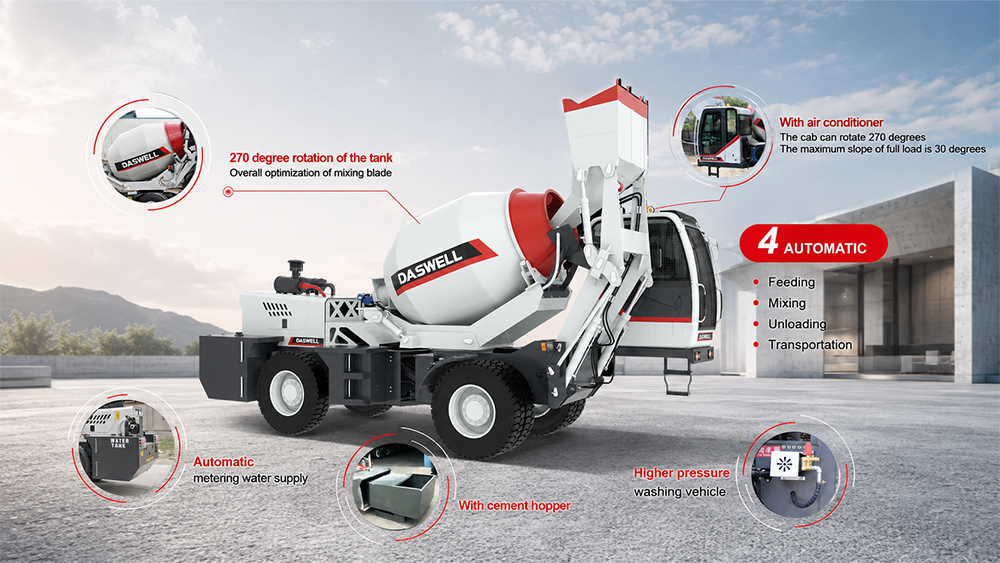
A self loading concrete mixer integrates loading, weighing, mixing, transportation, and discharging into one unit.
Automatic bucket loading
The loading bucket can directly load aggregates and cement. The operator can control the process from the cab, without an extra wheel loader or loading workers.
Electronic weighing system
The weighing system can measure sand, stone, cement, and other materials during loading. The water supply system helps control water volume.
This improves concrete mixing stability and reduces manual batching errors.
Continuous mixing during transportation
The mixing drum keeps rotating while the machine moves, so concrete remains fresh and uniform when it reaches the pouring point.
Contractors can discharge and pour directly without long waiting time.
270° rotating discharge
The mixing drum can rotate to discharge concrete in different directions. This is useful for road construction, foundation work, slope protection, and dam construction.
Built-in water tank and water pump
The machine comes with a water tank and water pump. It can work with a nearby water source, making it more suitable for remote jobsites.
How Can a Self Loading Concrete Mixer Reduce Construction Costs?
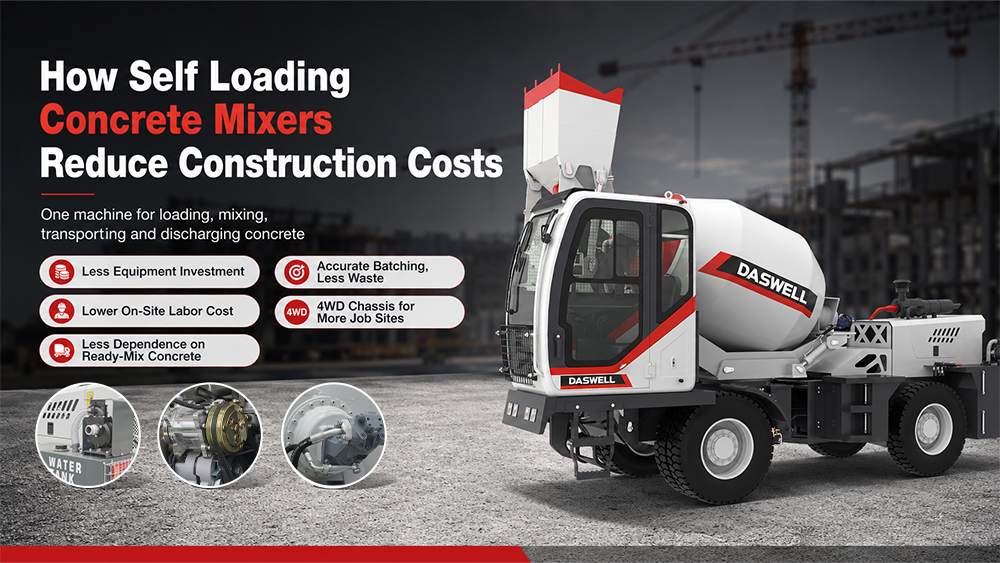
1. Reduce equipment investment
A self loading concrete mixer combines loading, mixing, and transportation in one machine. Contractors do not need an extra wheel loader, fixed concrete mixer, or concrete transport vehicle.
Compared with traditional methods using several machines, it can reduce purchase, rental, relocation, and maintenance costs.
For small and medium-sized contractors, one self loading concrete mixer truck is easier to manage and more cost-effective than several separate machines.
2. Reduce labor cost on site
A self loading concrete mixer is usually operated by one driver, who can complete loading, mixing, driving, and discharging.
Only a few auxiliary workers are needed. This helps reduce labor cost in loading, mixing, and transportation.
3. Reduce dependence on ready-mix concrete
For remote jobsites, ready-mix concrete may be expensive, slow to arrange, or unavailable.
With a self loading concrete mixer, contractors can purchase aggregates, sand, cement, and other raw materials directly, then produce concrete on demand at the jobsite.
This helps reduce transportation cost, waiting time, and high ready-mix concrete cost.
4. Improve batching accuracy and reduce waste
The weighing system can measure sand, stone, and cement in real time. The water system can add water according to the set proportion.
Compared with manual batching, this improves mixing uniformity and reduces the risk of unstable concrete strength.
Accurate batching also helps reduce material waste and quality risks in long-term projects.
5. Four-wheel drive chassis for wider jobsite use
Daswell self loading concrete mixer adopts a four-wheel drive chassis. It has a compact body, short wheelbase, and small turning radius.
It can work on muddy roads, slopes, mountainous roads, and narrow jobsites. This helps reduce downtime caused by poor site access.
Which Projects Are Suitable for Self Loading Concrete Mixer?
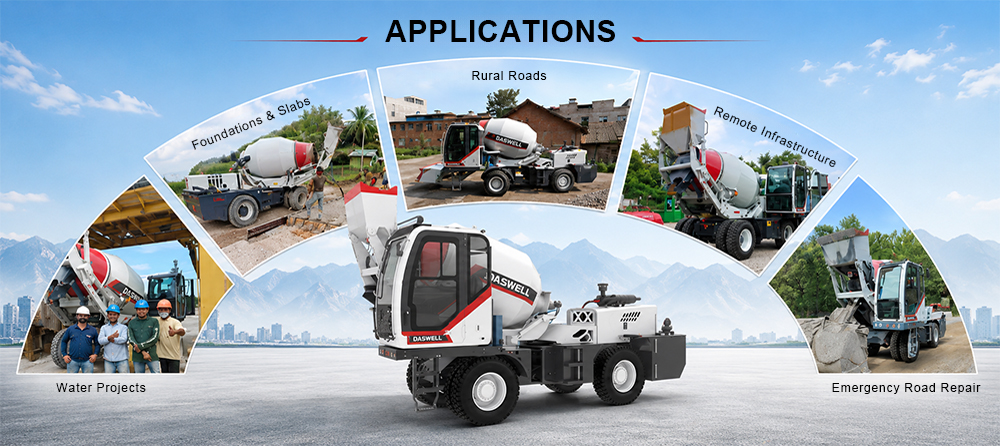
The self loading concrete mixer is suitable for road construction, bridge construction, factory building projects, slope protection, dam construction, foundation work, and floor pouring.
Rural road construction
Rural road projects often have scattered pouring points and poor access conditions. A self loading concrete mixer can drive directly to the construction point and produce concrete on site.
Water conservancy projects
For slope protection, dams, and canal projects, jobsites are often scattered and the construction period may be long. Producing concrete on site can reduce concrete supply cost.
Mountainous and remote infrastructure projects
When there is no nearby batching plant or mixer trucks cannot enter the site easily, a self loading concrete mixer is a flexible on-site concrete production solution.
Residential foundation and floor pouring
For small and medium-sized housing projects, daily concrete demand is usually not large. On-demand concrete production can reduce waste.
Road repair and emergency projects
A self loading concrete mixer can be deployed quickly. It is suitable for projects that need fast response and flexible concrete supply.
How to Choose the Right Self Loading Concrete Mixer Model?
Choosing the right self loading concrete mixer model is important. A model that is too large may increase unused capacity cost. A model that is too small may fail to meet the project schedule.
| Model | Mixing Capacity | Typical Application |
|---|---|---|
| SLDM1200 | 1.2 m³ | Rural housing, small foundation work |
| SLDM1800 | 1.8 m³ | Rural roads, small and medium-sized housing projects |
| SLDM2600 | 2.6 m³ | Road hardening, medium-sized construction projects |
| SLDM3500 | 3.5 m³ | Infrastructure projects, township road construction |
| SLDM4000 | 4.0 m³ | Commercial projects, higher daily output requirements |
| SLDM5000 | 5.5 m³ | Large infrastructure projects, continuous heavy-duty operation |
Daswell provides different self loading concrete mixer models. Customers can choose a suitable model according to rural housing, road hardening, infrastructure construction, and other project needs.
Please contact Daswell and provide your project type, daily concrete demand, jobsite terrain, and road conditions. Our engineers will recommend a suitable equipment solution based on your actual working conditions.
Self Loading Concrete Mixer vs Traditional Concrete Production Method
| Comparison Item | Traditional Method | Self Loading Concrete Mixer |
|---|---|---|
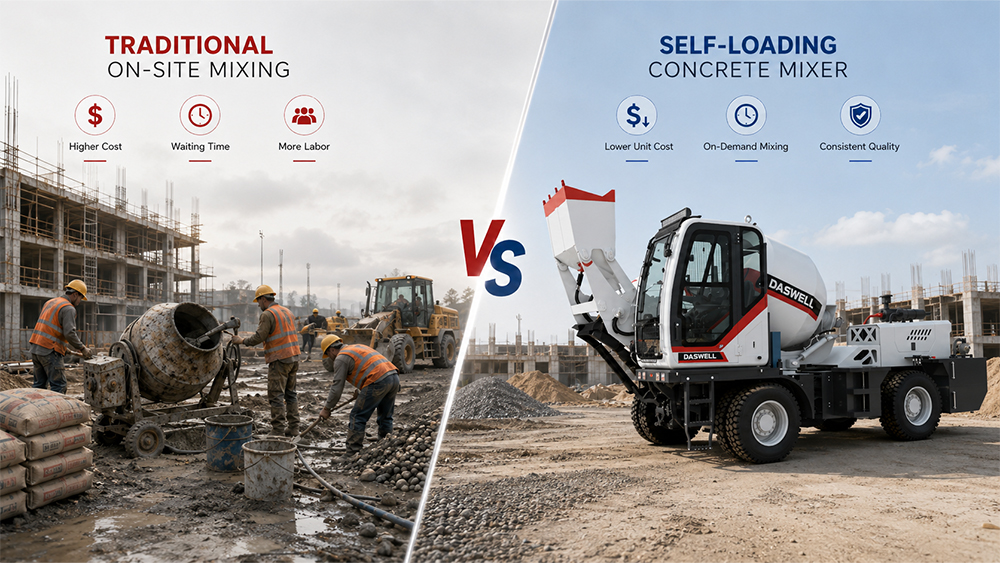
| Equipment quantity | Wheel loader + concrete mixer + transport vehicle | One machine |
| Operators | Several workers | Driver + a few auxiliary workers |
| Concrete source | Ready-mix concrete or external batching plant | On-site mixing with raw materials |
| Remote jobsite suitability | Limited by mixer truck access and batching plant distance | Strong, with four-wheel drive chassis and water tank |
| Batching accuracy | Depends on manual experience | Electronic weighing and automatic control |
| Quality stability | Long-distance transport may affect concrete condition | Fresh concrete mixed on site |
| Flexibility | Low | High |
| Overall cost performance | More equipment, labor, transport, and management steps | Easier to control on-site concrete production cost |
Contact Daswell
A self loading concrete mixer replaces several separate machines and workers in traditional concrete production. It integrates loading, batching, mixing, transportation, and discharging into one machine.
For road construction, rural construction, water conservancy projects, remote jobsites, and other small and medium-sized construction scenarios, it is a cost-effective concrete equipment solution.
Daswell provides self loading concrete mixer trucks with different capacities. We support global delivery and can provide installation, commissioning, operation training, and technical support.
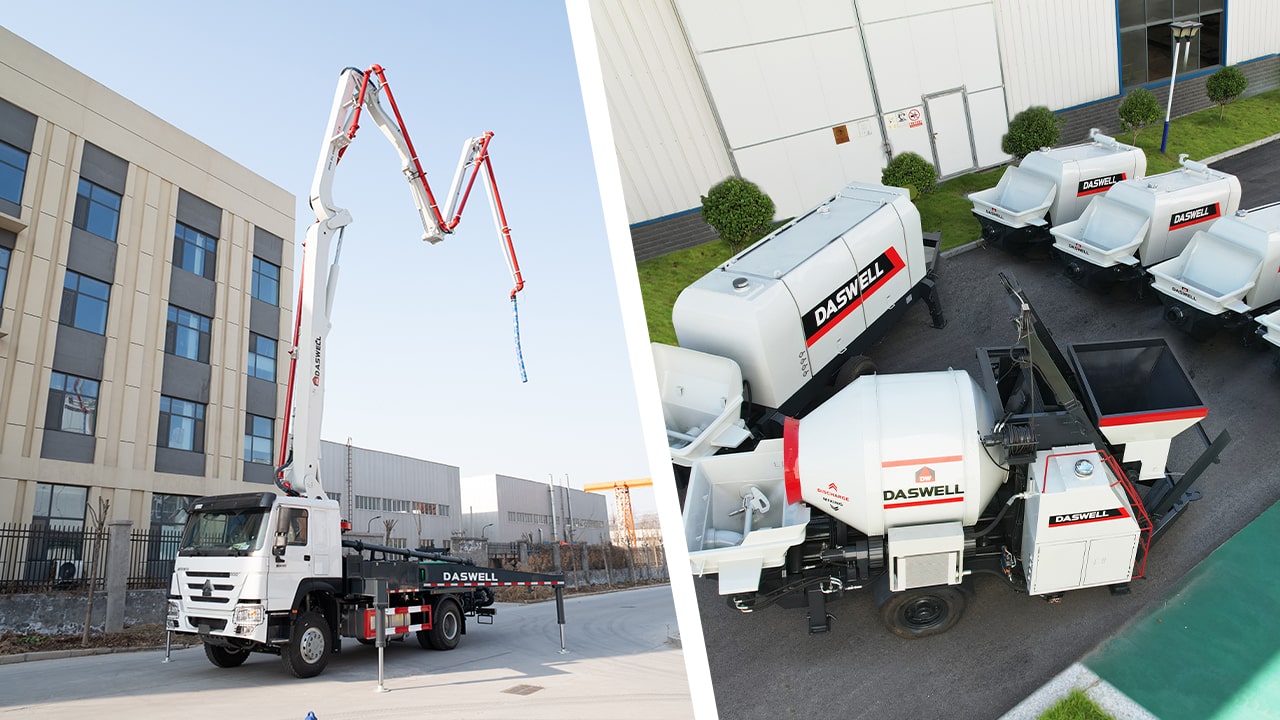
We also provide concrete mixer pumps, trailer concrete pumps, concrete batching plants, and other concrete equipment for construction projects.
If you have any questions, please contact Daswell for more information and a suitable equipment solution.