What Is a Concrete Mixer Pump conveniently Used For? Applications, Industries & Materials
In the construction of projects such as house foundations, rural roads, agricultural buildings, and small-scale drainage works, concrete mixer pumps are particularly well-suited for projects that require on-site mixing and the transport of concrete via pipelines.
They are especially useful in locations where transporting ready-mixed concrete is difficult, which depends primarily on the scale of the pour, the concrete mix design, and the delivery route. Now, let’s take a closer view on the specific applications of concrete mixer pumps!
What does a concrete mixer pump do?
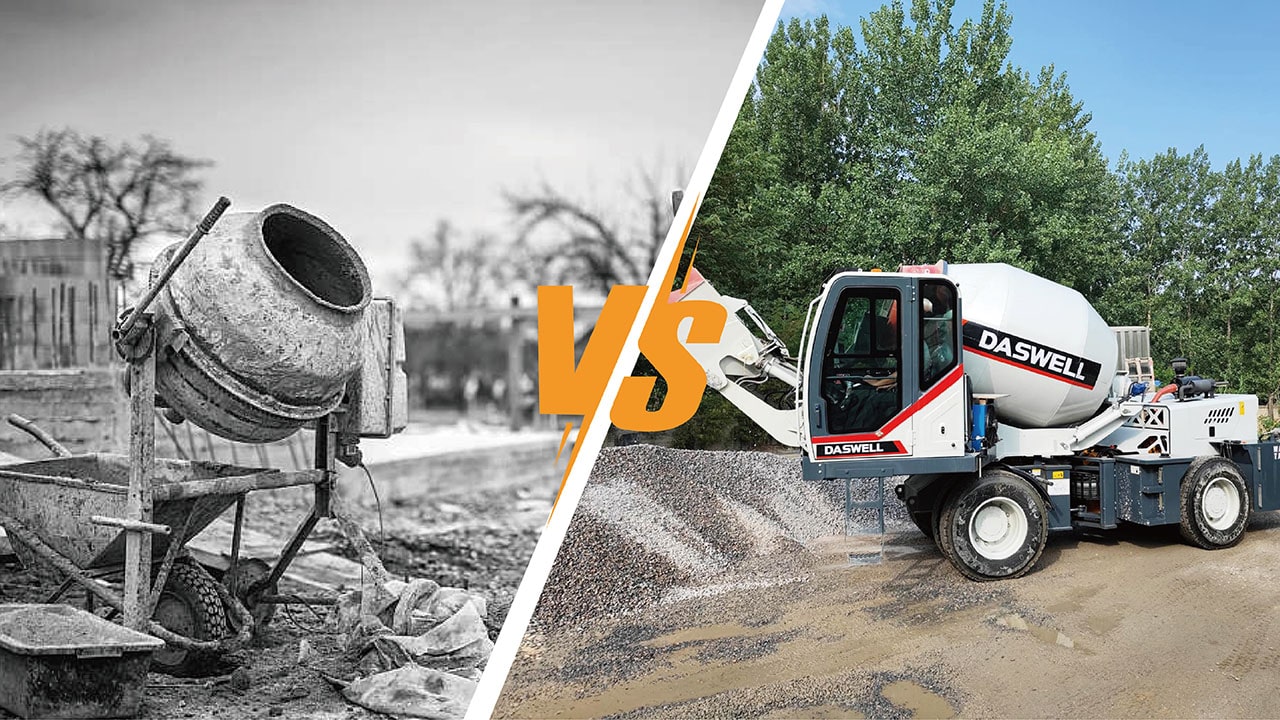
The key feature of the concrete mixer pump is the integration of the concrete mixer and the concrete pump into a unit.
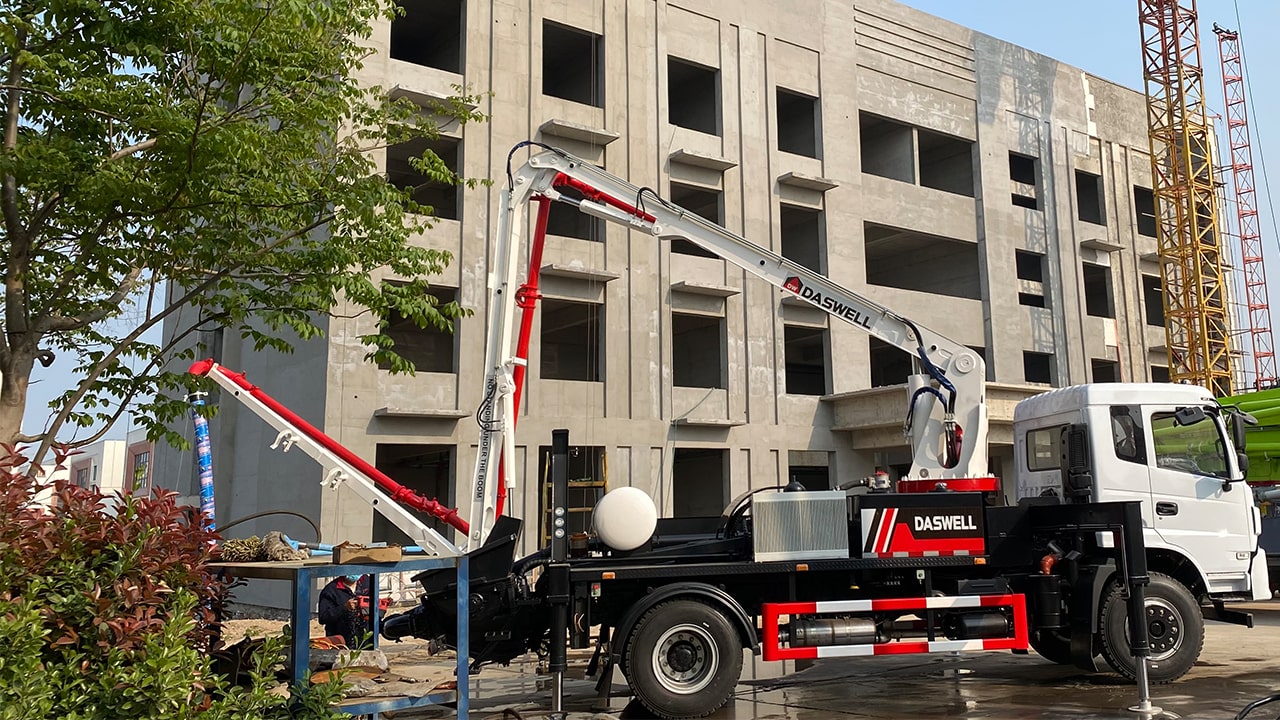
It can produce concrete on-site, then transport it to the pouring point via connected pipes and hoses.
- Load the accurately measured concrete raw materials into the mixer according to the design mix ratio.
- Mix the materials, then discharge the fresh concrete into the pump’s feed hopper.
- Pump the concrete through the delivery pipeline into the prepared forms.
Main concrete mixer pump applications by project
Here are a few common application areas.
application |
Typical concrete work |
why a mixer pump may fit |
what to check |
|
Residential construction |
House footings, slabs, beams, columns |
On-site mixing with delivery to individual pour locations |
Structural mix approval and placement sequence |
|
Small commercial construction |
Shop foundations, floors, renovation slabs |
Combined production and delivery for limited pours |
Achievable output within the finishing window |
|
Rural roads and local infrastructure |
Village road sections, shoulders, drainage channels |
Concrete production under conditions of difficult ready-mixed concrete supply |
Section volume and pipeline relocation |
|
Agricultural facilities |
Animal shelter foundations and slabs |
Local mixing at dispersed rural sites |
Specified strength and exposure requirements |
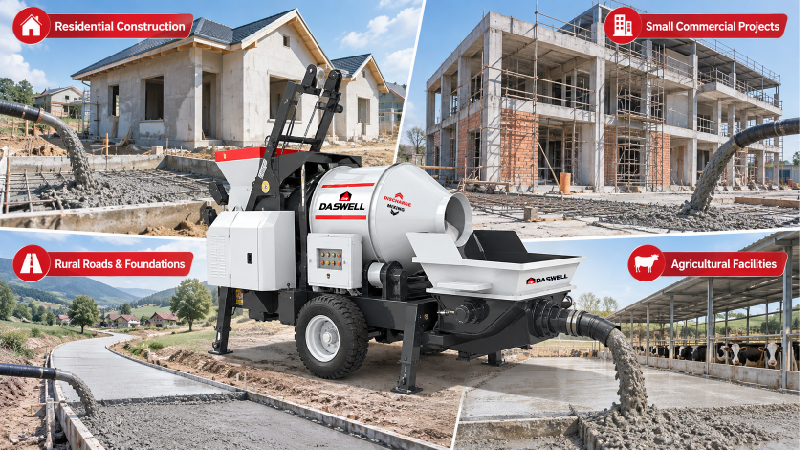
Residential construction
The construction of low-rise residential buildings typically involves multiple concrete pouring operations across various stages of the project. Conveying pipelines link the mixing point to the different work areas. Even on sites with limited space, sufficient room must be allocated for material stockpiling, mixer loading, and the safe operation and maintenance of the pipelines.
Small commercial construction
For shop construction or small-to-medium-sized renovation projects, our concrete mixer pump is an ideal choice, provided the site offers sufficient space for material measurement and mixing. The twin-shaft concrete mixer pump is perfectly suited for small-scale commercial pouring projects. However, it is worth noting that if your project involves pouring large-area floor slabs, you will need to verify that the production capacity can meet the demand for continuous supply.
Rural roads and local infrastructure
Do you have needs related to infrastructure construction? In rural road and drainage projects, construction sections are often delineated based on concrete production and pouring capacities. Consequently, factors such as equipment positioning and the frequency of pipeline repositioning become critical considerations. Longer pipelines entail a greater workload for installation, pumping, and cleaning.
Agricultural facilities
In agricultural operations, where structures are often scattered across various locations, ready-mix concrete trucks cannot always arrive on schedule; consequently, on-site mixing often proves to be the more reliable option. For elements like the foundations and flooring of livestock shelters, there is no room for compromise regarding concrete strength or durability, as these factors directly impact the stability of the future rearing environment.
What materials can a concrete mixer pump handle?
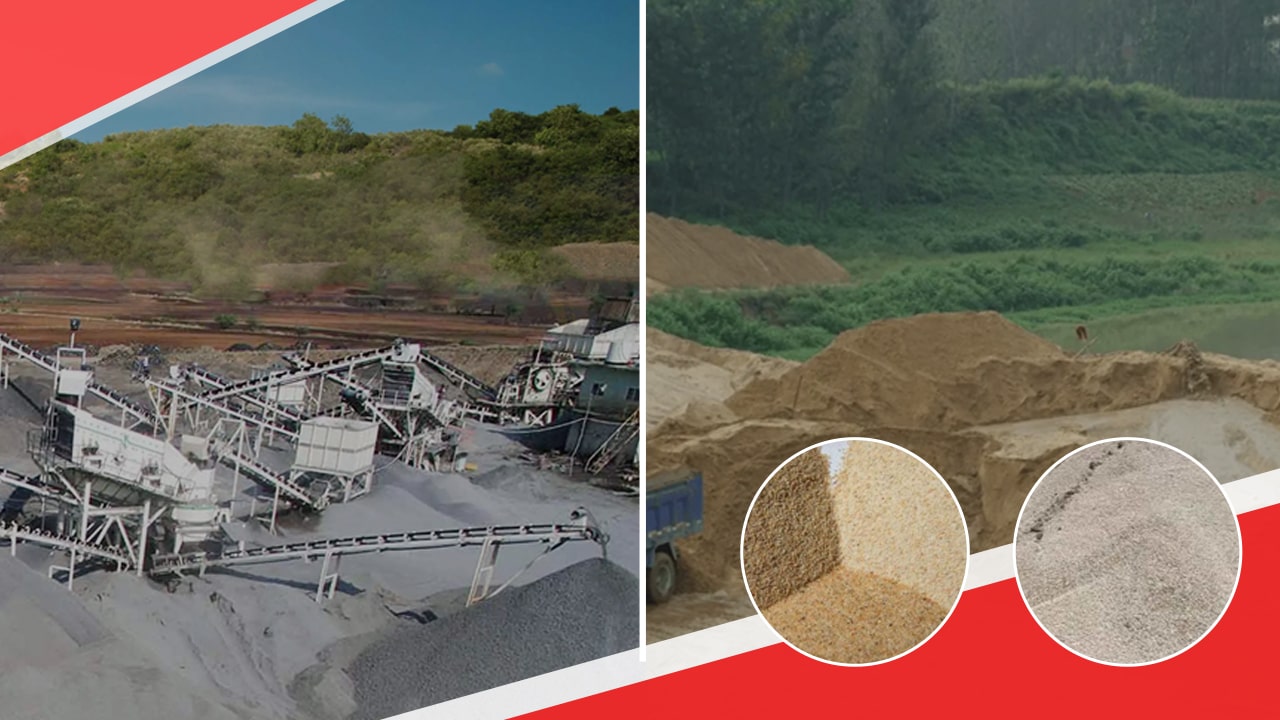
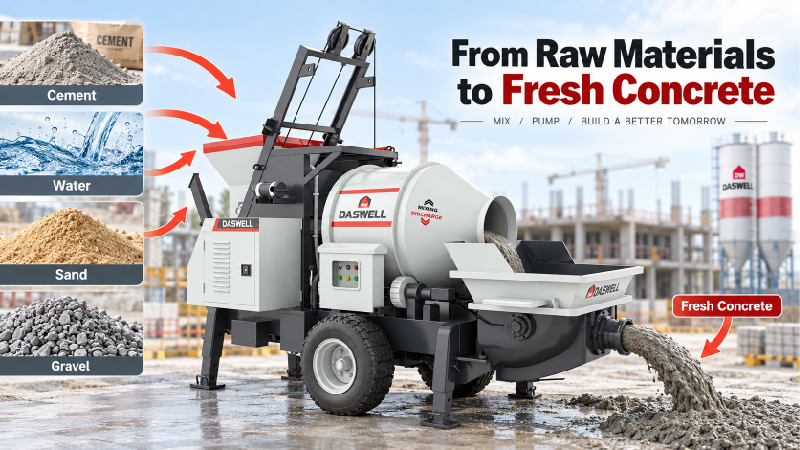
Freshly mixed concrete composed of cement, water, fine aggregates, and coarse aggregates.
Before entering the pumping system, these ingredients must be thoroughly mixed in the proper proportions.
The maximum aggregate size must be compatible with the equipment and piping, but gradation and particle shape are equally critical; angular, rough-textured aggregates increase water demand and impair workability. It is recommended to follow relevant ACI standards for concrete mix design.
Workability refers to the handling and placement characteristics of fresh concrete. Pumpable concrete must possess good uniformity to prevent segregation during transport. ACI guidelines for pumping emphasize three fundamental requirements: accurate proportioning, thorough mixing, and proper gradation.
Adding water does not improve pumpability; excessive water reduces strength and durability. Chemical admixtures should be the primary means of adjusting workability, and their use must comply with the approved mix design. NRMCA imposes clear limits on adding water at the job site, which must be strictly observed.
For materials with special mix designs—such as mortar, grouting materials, fiber-reinforced concrete, and lightweight aggregate concrete—the suitability of the specific mixer-pump model must be verified prior to selection.
Variations in raw material properties and pipeline configurations can affect compatibility regarding mixing and pumping; therefore, verification should be completed before construction begins. Due to their low density and high water absorption, lightweight aggregate concretes require particular attention regarding segregation control.
General pumping guidelines typically do not cover such special materials or compatibility issues between equipment and shotcrete; consulting specialized technical documentation or the manufacturer is recommended. For materials prone to causing pipe blockages—such as fiber-reinforced concrete and grouting materials—conducting trial mixes and test pumps prior to actual construction can effectively mitigate compatibility risks.
Application example: building construction in Indonesia
This case study comes from the DMP50 construction project in Indonesia.
The client required on-site concrete mixing with direct pumping to the pouring location.
While separate mixer and trailer pump configurations were initially considered, the client ultimately opted for a concrete mixer-pump—a single unit that integrates both mixing and pumping functions.
Unstable local power supply was a key factor in this decision; a diesel-powered solution effectively eliminated the risk of power outages.
When selecting equipment, the method of concrete supply and on-site power conditions serve as two critical constraints.
The supply method determines whether to use ready-mix concrete or on-site mixing, while power conditions dictate whether to connect to the grid or use an independent power source.
These prerequisites must be established before refining details such as the mix design, pipeline routing, and pouring rate; the sequence cannot be reversed.
FAQ: you might often consider
Can concrete mixing pumps be used for high-rise pouring?
It is possible, but the number of floors alone is not enough to make a determination. Before planning high-altitude pouring operations, be sure to verify the selected model’s vertical delivery height, the overall pipeline layout, the configuration of pipe bends, concrete properties, and the required flow rate.
Does higher slump mean better pumpability?
No. Slump only indicates concrete consistency; it does not fully describe pumpability. Aggregate gradation, mix stability, and equipment configuration are equally critical. Even if the concrete mix appears to have good fluidity, adjustments and pumpability tests may still be necessary!
Discuss your application needs with DASWELL!
The success of a concrete mixer pump depends on the alignment of the construction task, material properties, and the delivery plan. Share your project details with DASWELL, and our team will evaluate the suitability of the mixer pump for your pouring schedule and provide recommendations on the right model.