Concrete Batching Plant Cost: Equipment, Installation and Operating Budget
Concrete batching plant prices depend on equipment configuration, component brands, supply scope, and service coverage. Daswell Group explains three key concerns for customers: What does the equipment price include? What additional costs arise between delivery and commissioning? How can monthly operating costs be estimated? At the end of this article, you will find a budget table you can use to organize your own figures.
If you would like to compare different types of concrete batching plants first, please see our mobile concrete batching plant and stationary concrete batching plant pages.
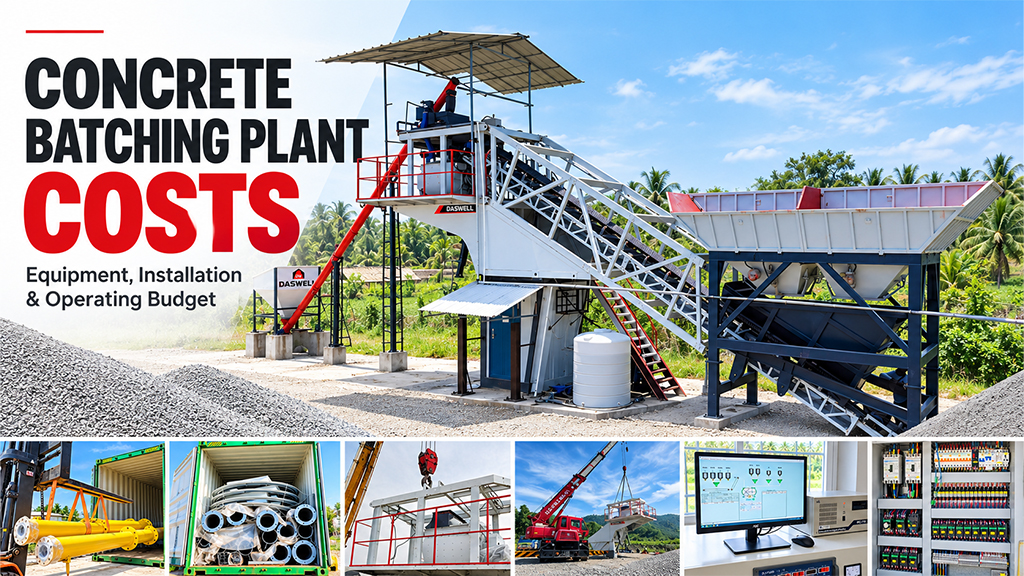
What Does a Concrete Batching Plant Price Include?
| Component | What to Confirm |
|---|---|
| Mixer | Twin-shaft or planetary mixer; model and batch output (for example, a JS1000 twin-shaft mixer produces 1 m³ per batch) |
| Aggregate batching system | Number and capacity of aggregate bins; weighing hopper; skip hoist or belt conveyor feeding |
| Powder system | Whether cement silos are included or optional |
| Screw conveyors | Quantity and specifications |
| Weighing system | Scales, load cells, and weighing accuracy |
| Control system | PLC and software; whether a control room is included |
| Pneumatic system | Whether an air compressor is included |
| Cleaning and dust collection | Cleaning system |
| Spare parts | Which wear parts are included in the initial shipment |
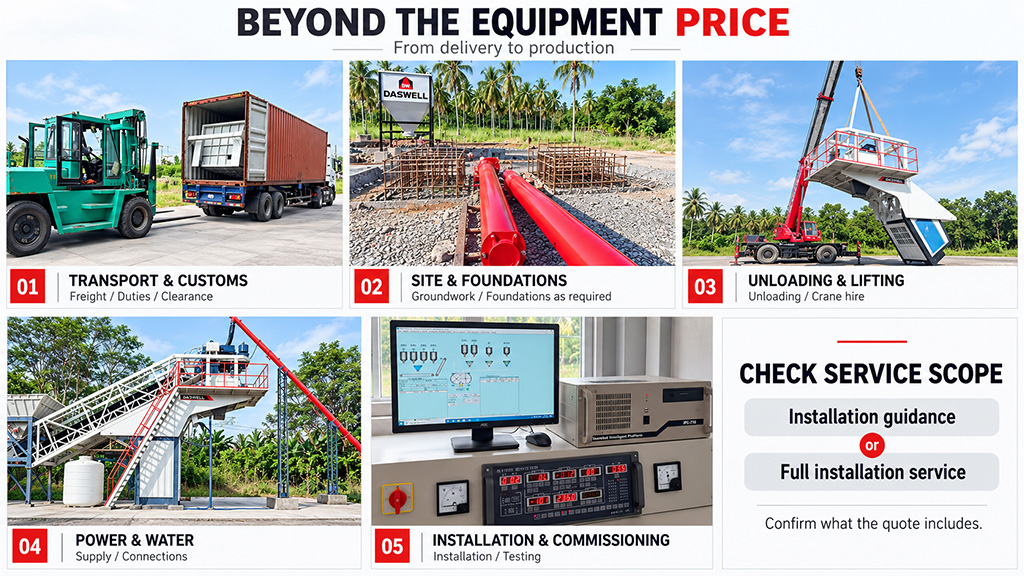
What Additional Costs Are Involved Before a Batching Plant Starts Production?
- Shipping, customs duties, and customs clearance.
- Site and foundations. The buyer usually handles the foundations for the mixing tower, cement silos, and aggregate bins at a stationary plant, along with drainage and washdown areas. Daswell mobile batching plants do not require foundations.
- Unloading and lifting. Budget for unloading the equipment and lifting cement silos and the mixing tower into position.
- Power and water connections. Daswell mobile batching plants have a total installed power of 40–135 kW, depending on the model. Check whether your power supply, transformer, or generator can handle the load.
- Installation and commissioning. This is one of the biggest differences between supplier quotations. Ask whether the supplier provides installation guidance, such as drawings and remote support, or a complete installation service.
A mobile batching plant can shorten this stage. A lower-priced plant may cost more overall if it only comes with installation guidance, while a more expensive package may include installation. Neither option is necessarily wrong. The key is to understand exactly what you are buying.
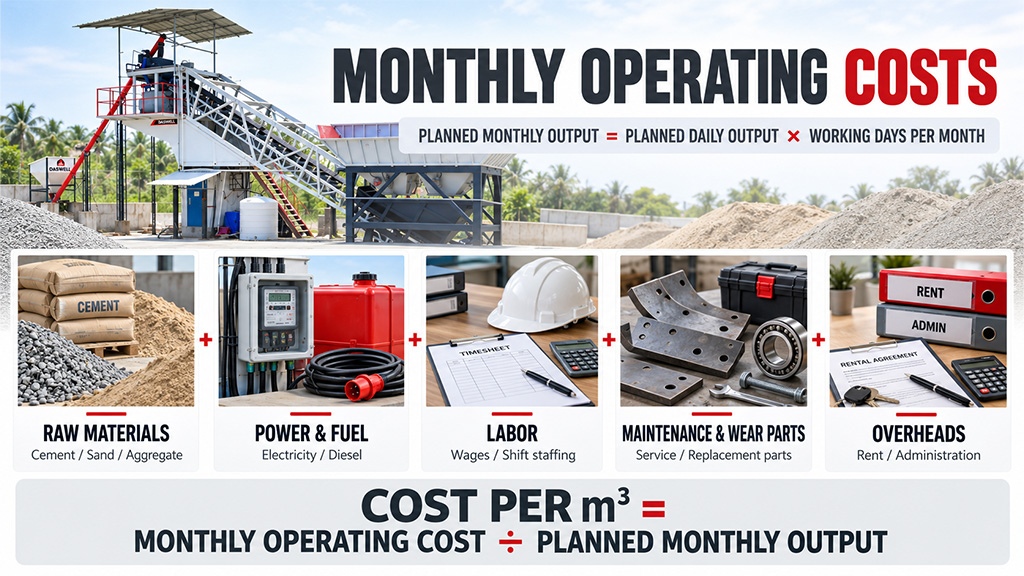
How to Estimate Monthly Concrete Batching Plant Operating Costs
For most buyers, operating costs over several years matter more than the initial purchase price. Costs vary significantly by country and project, so use your own operating data to make realistic estimates.
Step 1: Calculate output based on your production plan, not the rated capacity.
Rated capacity is calculated from the production cycle time. For example, a CBP60 batching plant equipped with a JS1000 mixer has a batch output of 1 m³. With a 60-second production cycle, its theoretical output is:
3,600 ÷ 60 × 1 = 60 m³/h
This calculation assumes that trucks are always ready, batches run continuously without delays, and materials are always available. Actual output depends on truck turnaround, aggregate moisture content, mix design changes, and downtime.
Use this formula to estimate monthly production:
Monthly production (m³) = Planned daily production (m³) × Working days per month
Base your estimate on the actual volume your project needs and the time available for production.
Step 2: Estimate each operating cost.
| Cost Item | Estimation Method |
|---|---|
| Raw materials | For each mix design, multiply the quantity of each material by its delivered price, then multiply by planned monthly production. Add an allowance for material loss. |
| Electricity and fuel | Total installed power is not the same as actual average power consumption. Monthly electricity cost ≈ electricity consumption per m³ × planned monthly production × local electricity rate. Add diesel costs for loaders, trucks, and generators. |
| Labor | List the actual job roles, workers per shift, local wages, and related employment costs. |
| Maintenance and wear parts | Use the supplier’s wear-part list and prices. Convert expected replacement intervals into months, then estimate the monthly cost based on unit prices, replacement quantities, and replacement intervals. Add lubricants, inspection and repair labor, and scale calibration. |
| Other operating expenses | Include land rent, administration, and other recurring costs based on actual contracts and expenses. |
Step 3: Calculate the operating cost per cubic meter.
Operating cost per m³ = Total monthly operating costs ÷ Monthly production (m³)
How to Estimate the Startup Budget for a Concrete Batching Plant
Your batching plant budget should cover more than the equipment price. From signing the contract to starting production, you may also need to pay for transportation, site preparation, installation, and initial operating expenses.
Equipment and auxiliary equipment
First, confirm which equipment is included in the plant quotation. Check the actual supply scope for cement silos, screw conveyors, loaders, trucks, initial wear parts, and other equipment. If any items must be purchased separately, include their costs in your budget.
Transportation, installation, and site preparation
After the equipment arrives, additional costs may include international shipping, customs clearance, import duties, site construction, lifting, power and water connections, and installation and commissioning. If the supplier needs to send engineers to your site, confirm who will cover their flights, accommodation, and local transportation.
Initial operating funds
You also need enough working capital for the early stages of production. This includes purchasing cement, aggregates, and other raw materials, paying employee wages, covering electricity and fuel, and setting aside funds for unexpected repairs or other expenses.
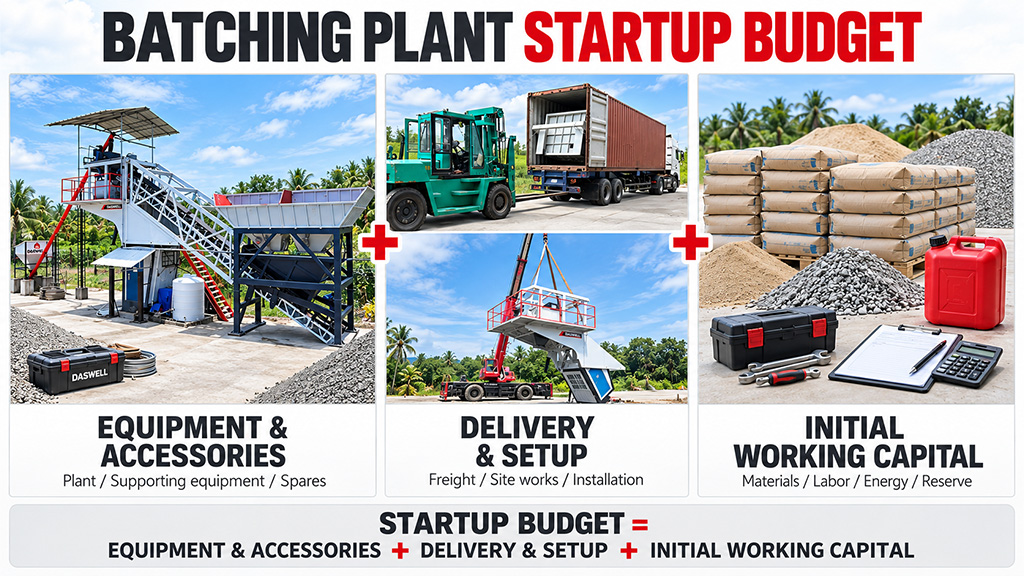
Use the following formula to estimate your startup budget:
Startup budget = Equipment and auxiliary equipment costs + Transportation and commissioning costs + Initial operating funds
Use the table below to organize your budget. Base your figures on actual supplier quotations and costs at your project location.
| Budget Item | Main Costs | Estimated Amount |
|---|---|---|
| Equipment and auxiliary equipment | Total plant contract price, additional equipment, spare parts | |
| Transportation and site commissioning | Freight, customs duties, clearance, foundation work, lifting, power and water connections, installation and commissioning | |
| Initial operating funds | Raw materials, wages, electricity, fuel, insurance, and contingency funds | |
| Total startup budget | Sum of the three items above |
When comparing quotations from different suppliers, look beyond the total plant price. Check which equipment and installation services are included and whether additional charges will apply later. Do not count costs that are already included in the quotation. Add only items that are excluded or charged separately.
Contact Daswell Group for a Concrete Batching Plant Quote
Send these details to Daswell, and our team will help you confirm the equipment configuration and supply scope. Contact Daswell
- Project country and location
- Stationary or mobile
- Daily concrete demand / work schedule
- Powder and aggregate materials
- Site conditions
- Power supply conditions
- Climate conditions