Self Loading Concrete Mixer Applications: 5 Practical uses
In concrete construction, the ability to secure a stable and timely supply of concrete directly impacts the project schedule. While large-scale construction projects can typically rely on concrete batching plants to meet continuous, high-volume demands, how do you handle situations—such as road or residential construction—where work sites constantly shift and concrete requirements fluctuate significantly across different project phases?
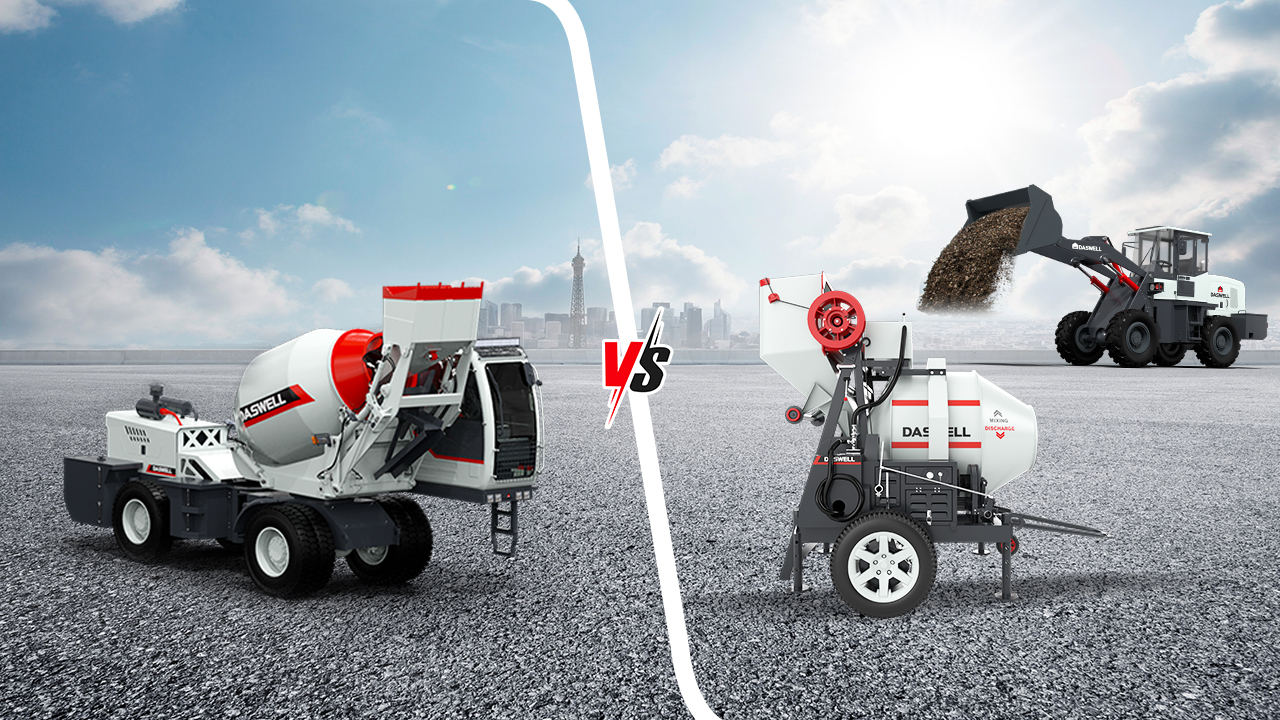
Self loading concrete mixer offers an alternative solution. These vehicles integrate functions such as aggregate loading, weighing, water addition, mixing, and short-distance transport into a single unit, thereby reducing reliance on external concrete transport vehicles.
Next, I will introduce five common applications for self loading concrete mixers and illustrate them using real-world examples from DASWELL.
Road and Pavement Construction
• Why are self loading mixers suitable for road construction?
Road construction is one of the most common applications for self loading concrete mixers. Beyond rural roads, they are also suitable for community roads, internal factory roads, parking lots, temporary construction access roads, and various pavement surfacing projects.
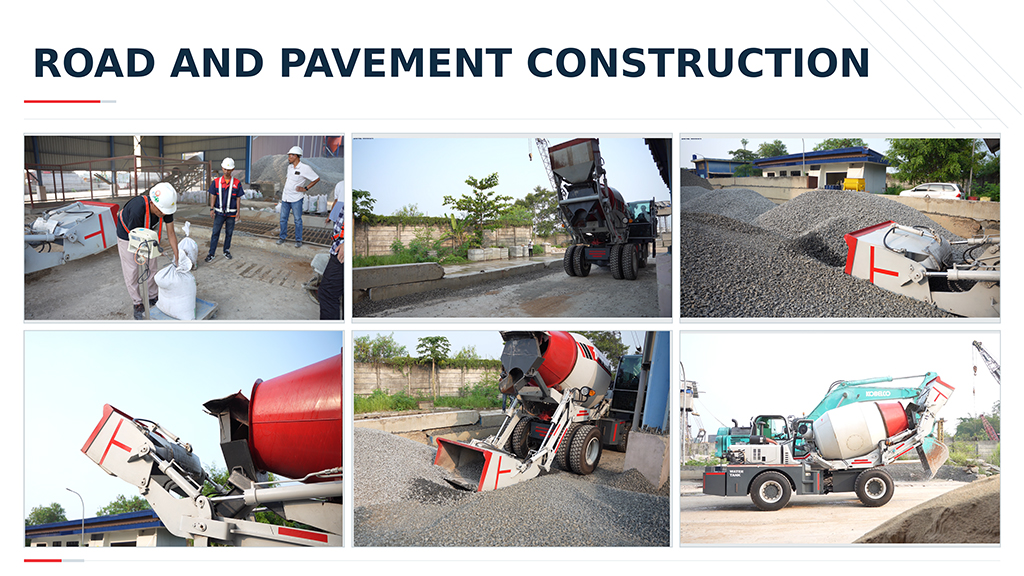
These projects share a common characteristic: the work area often extends along the length of the road, and the concrete pouring location shifts as the project progresses.
Take rural road construction as an example: you may work in sections across a stretch of road spanning hundreds of meters or even several kilometers. Self loading concrete mixers can mix concrete in safe zones and transport it directly to the specific pouring location, adapting to the road conditions on-site. This approach eliminates the need for separate concrete transport logistics and allows for more flexible scheduling.
• What should be considered when choosing a self loading concrete mixer?
Self loading concrete mixers are often the ideal choice for road projects that cover long distances but have moderate concrete volume requirements at any single work point. However, they are not necessarily suitable for every type of road project.
If you requires the continuous pouring of large volumes of concrete within a short time, you must carefully evaluate the equipment’s actual production capacity, transport cycle times, and pouring speed.
Furthermore, the pavement concrete must meet specific standards for strength, workability, and construction quality. On-site production requires strict control over mix proportions, water content, and mixing quality; concrete performance must never be compromised in the pursuit of faster construction speeds.
Residential Building Construction
• For which types of residential construction are self loading concrete mixers suitable?
Self loading concrete mixers are primarily suitable for the construction of single-family homes, low-rise residences, villas, and small-scale residential developments. Concrete requirements for these types of projects vary depending on the construction phase.
During the foundation phase, the typical workflow involves pouring the foundation bedding, foundation beams, or other structural elements; subsequently, work may shift to floor slabs, courtyard pathways, perimeter wall foundations, and other ancillary structures.
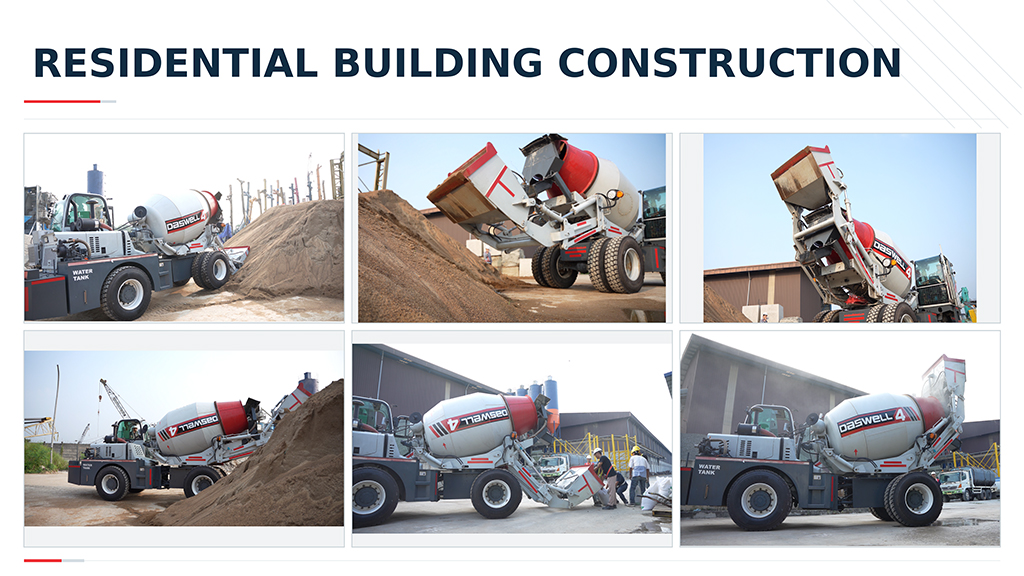
Residential projects entail varying concrete volumes, pouring schedules, and work locations across different construction stages. Provided there is sufficient space on-site for raw material storage and equipment operation, self loading concrete mixers can flexibly produce concrete in line with the construction schedule to meet the specific needs of each phase.
However, for load-bearing structures such as foundations, beams, columns, and floor slabs, construction teams must still strictly control concrete strength, mix proportions, and construction quality. If high-strength concrete or large-scale continuous pouring is required, the equipment’s production capacity and quality control capabilities must be further evaluated.
Therefore, the self loading concrete mixer is best utilized for its flexibility in on-site production and adaptability to multi-stage construction, rather than as a total replacement for all other concrete production equipment.
• How do they enhance construction flexibility for residential projects?
A comprehensive residential construction process typically involves the coordination of multiple procedures. Specific sequencing exists between tasks such as rebar tying, formwork installation, foundation preparation, and concrete pouring.
Using a self loading concrete mixer allows for the independent scheduling of concrete production, thereby reducing the coordination pressure caused by fluctuations in external delivery times.
Residential construction often involves entire neighborhoods or clusters of homes rather than isolated, single units. Consequently, for small-scale developments comprising multiple adjacent units, self loading concrete mixers offer great flexibility by allowing the equipment to move between different work zones according to the construction plan.
For instance, a construction team might complete the courtyard flooring for one house and then need to pour the foundation for an ancillary structure at another. Provided site access and equipment conditions permit, a single unit can handle concrete production and transport tasks across these different locations.
Projects in Rural and Remote Areas
• Self-loading mixers suited for dispersed construction sites
For construction projects involving mountain villages, remote residences, or small-scale infrastructure, concrete supply often poses a challenge for construction teams. The lack of nearby commercial ready-mix concrete plants, combined with poor road conditions, means that even for small-volume projects, long-distance transport can drive up costs and cause delays.
If raw materials are available on-site, self-loading mixers can produce concrete directly at the location, thereby reducing reliance on long-distance transport.
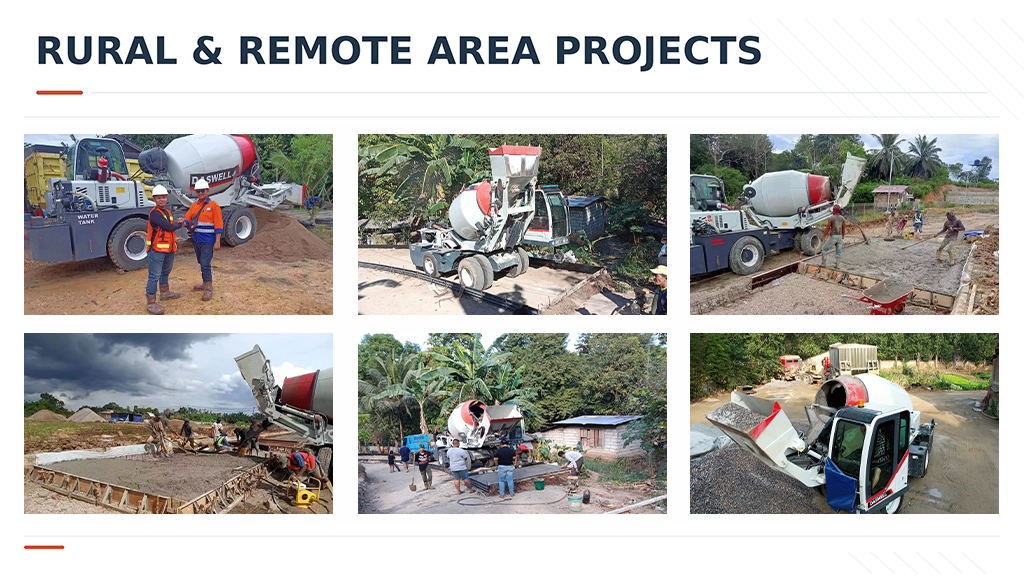
This equipment also offers advantages for projects with dispersed work sites. For instance, rural infrastructure projects might simultaneously involve road paving, drainage systems, and small public buildings, yet the concrete volume required at each specific site may not justify the installation of dedicated stationary mixing equipment. But, self loading concrete mixers can be moved between sites according to the construction schedule, maximizing equipment utilization.
However, construction teams must still assess local road gradients, load-bearing capacities, and turning radii in advance to ensure the equipment can navigate safely. It is crucial that a continuous supply of raw materials must be maintained to prevent production stoppages caused by material shortages.
• Reducing reliance on long-distance concrete supply
As previously mentioned, projects in remote mountainous areas are often far from the nearest commercial ready-mix concrete plant, requiring transport vehicles to traverse narrow or rugged roads to reach the site. Under these circumstances, teams face not only transport costs but also issues regarding transit time, road accessibility, and changes in concrete workability during transport.
Using self loading concrete mixers allows raw materials to be transported to the site in advance, with concrete production scheduled according to the project’s progress. While this does not entirely eliminate transport costs, it significantly reduces dependence on the long-distance delivery of finished concrete.
This on-site production method is particularly advantageous for projects spanning weeks or months where daily concrete requirements are relatively low, as it allows for better alignment with the actual pace of construction.
Agricultural Infrastructure Construction
• Farm Roads and Concrete Flooring
With economic development, modern agriculture has evolved beyond simple subsistence farming into a sector requiring extensive infrastructure construction—such as internal farm roads, agricultural warehouses, and flooring for livestock facilities—all of which utilize concrete.
These projects are typically spread across large areas of land; while they do not require the continuous, high-volume concrete production typical of large-scale infrastructure, they often necessitate phased pouring across different zones. Like road construction, the work involves mobile operations.
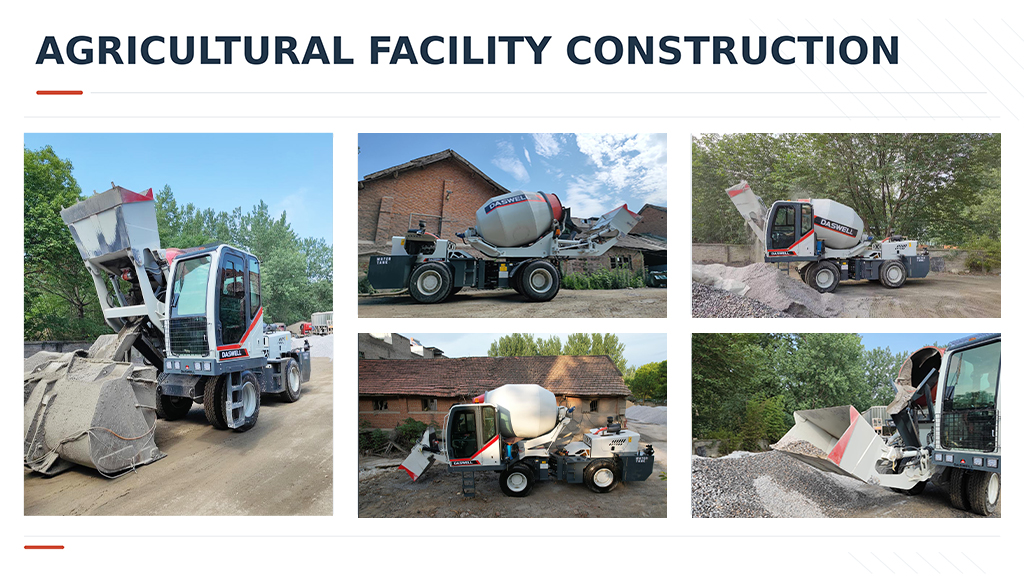
Internal farm roads must accommodate agricultural vehicles, transport equipment, and other machinery. Farms also require concrete flooring for tasks such as loading and unloading produce, parking equipment, and conducting daily operations.
This is where the mobility and flexibility of self-loading concrete mixers prove invaluable. Construction teams can complete the flooring around a warehouse before moving to the next site—such as a farm road or another facility—without difficulty.
• Irrigation and Drainage Facilities
In agricultural irrigation projects, concrete is frequently used for canal lining, drainage ditches, and various auxiliary water management structures. These projects are also geographically dispersed, typically distributed along the edges of farmlands or irrigation routes.
However, agricultural construction environments present unique challenges. For instance, the ground near farmlands may be soft, and conditions such as mud or standing water can arise during the rainy season. Construction teams must verify travel routes and ground-bearing capacity in advance to prevent vehicles from getting stuck.
For projects such as livestock facility flooring and drainage channels, it is also essential to select the appropriate concrete mix design based on the specific operating environment and to ensure proper waterproofing, durability, and surface finishing.
Small-Scale Infrastructure and Maintenance Projects
• Self-loading mixers meet small-batch, intermittent concrete needs
Construction teams frequently undertake small-scale infrastructure construction and maintenance tasks in urban communities, townships, and industrial parks.
Examples include sidewalk construction, drainage ditch installation, foundations for small public facilities, pavement repairs, and building extensions.
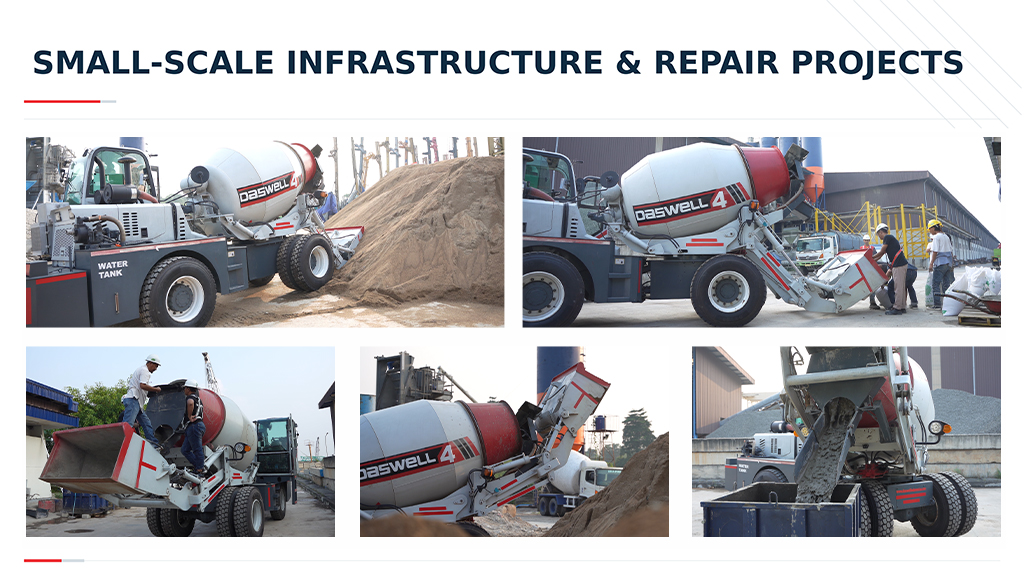
These projects share three characteristics: limited concrete volume requirements per site, potentially discontinuous work schedules, and the need for frequent relocation of operations.
Opting for a self loading mixer can help mitigate mismatches between concrete supply and construction progress. Naturally, small-batch operations still require precise control over raw material quantities; mix design specifications must not be overlooked simply because the production volume per batch is low.
• Self-loading mixers are suitable for multiple, dispersed small-scale projects
For contractors handling a mix of road repairs, drainage installations, and auxiliary construction works, equipment capable of moving between sites offers significant practical value.
For instance, teams can schedule the equipment for different sites on different days according to the project plan, eliminating the need to set up dedicated, stationary concrete production facilities for each small project.
Of course, the economic viability of this approach depends on factors such as the distance between sites, equipment relocation costs, staffing requirements, and actual usage frequency.
Therefore, we recommend that customers evaluate the value of the equipment based on the overall project schedule, rather than making decisions solely based on the concrete volume required for a single job.
How to choose the right self loading concrete mixer?
Having understood these applications, the next step is to consider the key factors that determine which equipment specifications best suit your project.
First, determine the volume of concrete required per day or per hour.
Road construction may require continuous paving of a specific area within a set timeframe, whereas concrete needs for residential projects might be spread across various construction phases.
When evaluating options, do not focus solely on the equipment’s nominal batch mixing capacity; also consider the actual output per batch, loading time, mixing time, transport distance, and discharging time.
If the project requires a continuous, high-volume supply of concrete, a stationary mixing plant or other production solutions might be more suitable.
Self-loading concrete mixers must move around the site, so road conditions directly impact their suitability.
The equipment’s self-mobility is limited. For projects in mountainous areas, farms, or remote locations, factors such as road gradients, ground load-bearing capacity, turning radii, and available workspace require careful attention.
Additionally, verify that the equipment can travel safely when fully loaded and that there is sufficient space on-site to perform loading, mixing, and discharging operations.
A stable supply of raw materials is a prerequisite for on-site concrete production using a self-loading mixer.
Therefore, before purchasing the equipment, ensure the availability of cement, aggregates, and water for construction.
For structural projects or concrete requiring specific performance characteristics, consider the equipment’s batching accuracy, mix ratio control capabilities, and necessary quality testing measures.
If you only need to complete a short-term, small-scale project, this self loading concrete equipment may not be the most economical choice.
However, if the construction team regularly undertakes road building, residential construction, or small-scale infrastructure projects—allowing the equipment to be reused across multiple sites—a self-loading concrete mixer can deliver greater long-term value.
When selecting equipment, it is necessary to comprehensively compare factors such as purchase cost, fuel consumption, labor costs, maintenance expenses, and projected usage frequency.
Different models of self-loading concrete mixers vary in terms of mixing capacity, power configuration, driving performance, and discharge methods.
For residential construction projects with limited workspace, equipment dimensions and maneuverability are often critical; conversely, for road and infrastructure projects, the primary considerations shift to concrete supply efficiency and transportation conditions.
The versatility of self loading concrete mixers makes them suitable for a wide range of concrete construction scenarios.
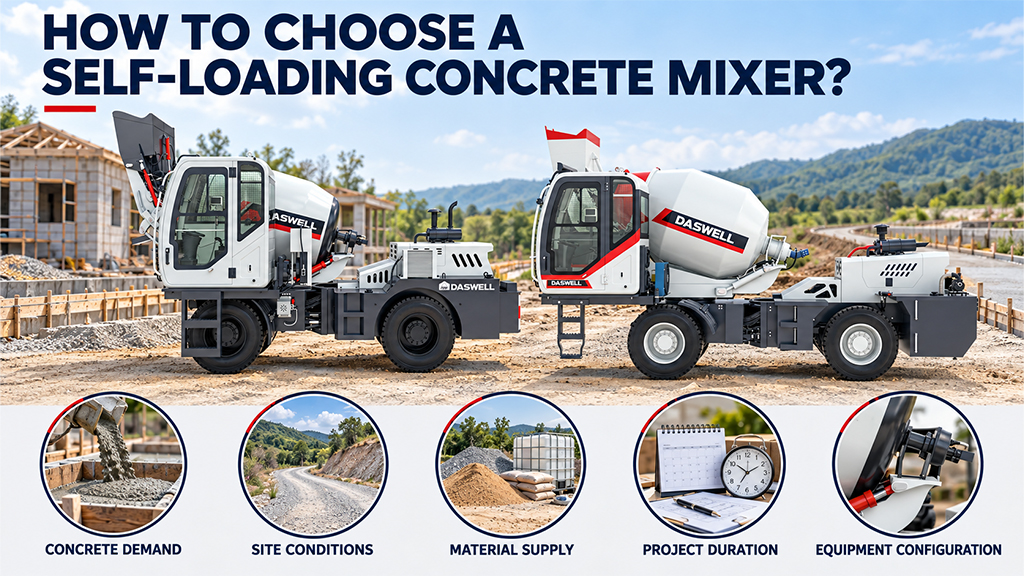
Although these projects serve different purposes, they often share common requirements: widely dispersed work sites, the need for flexible concrete supply arrangements, or a situation where continuous reliance on external ready-mix concrete delivery is impractical.
DASWELL offers concrete mixers tailored to diverse construction needs.
If you are unsure which model to choose, please feel free to provide us with more details; our team can assist you in evaluating the most suitable equipment solution.